
You know that feeling when the traffic light stays red for too long, the background noise seems never-ending, and the city closes in on you? Sometimes all it takes is getting in the car and driving for an hour in any direction to find yourself in another world: water flowing over rock, forests that muffle every sound, air that smells of wet grass.
The real Lazio is full of these places. Waterfalls hidden in tuff gorges, emerald lakes protected by nature reserves, trails that lead far from the chaos without requiring an intercontinental flight.
Whether you live in Rome and are looking for a last-minute getaway, or you’re planning a weekend in Lazio from out of town, this guide is designed for you: you’ll find not only the classic postcard spots, but also truly off-the-beaten-path corners, perfect for those who prefer discovery over mass selfies.
For each location, you’ll find up-to-date information on trails, access, costs, and crowd levels —because planning matters too.
Picchio Waterfall
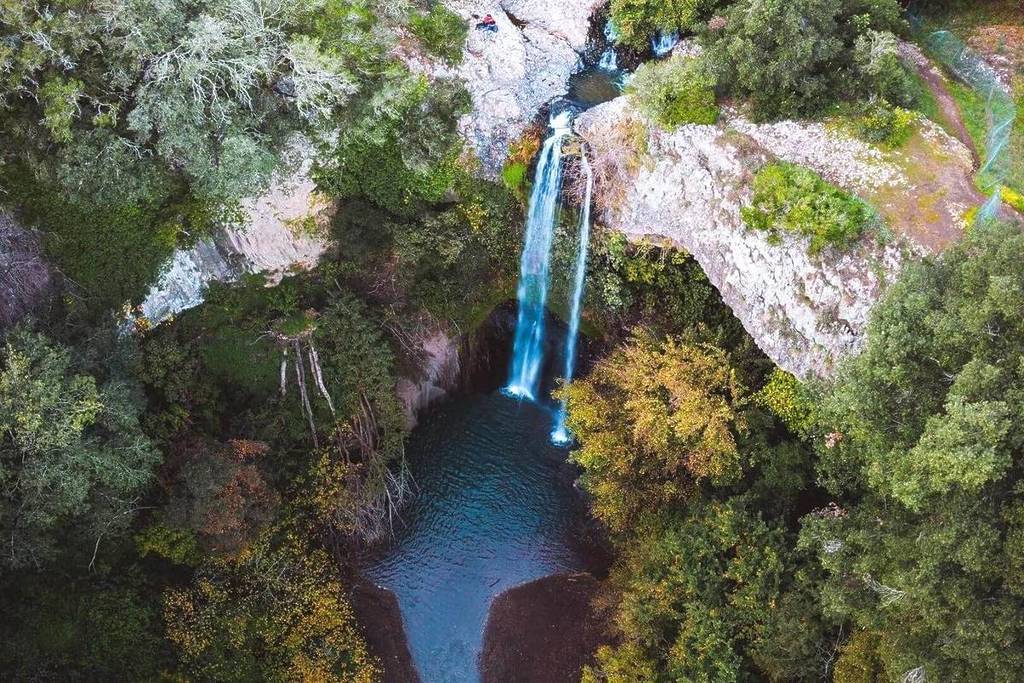
Within the tuff gorges surrounding Nepi lies a landscape that seems suspended in time: moss-covered green rock walls, sunken roads carved by the Etruscans, and a shady forest that leads all the way to the Cascata del Picchio, set within a spectacular drop in the gorge below. The trail starts from the historic center of Nepi—well-maintained, clean, and clearly marked—and covers about 3.5 km one way, with a difficulty rating of E (CAI Hiking).
Note: in some spots, you’ll need to use fixed ropes and cross small fords; hiking boots are essential. It’s worth combining your visit with a trip to the Arnaro Caves and the Cavaterra Waterfalls, which are nearby. It’s not a crowded place: the technical nature of the trail keeps weekend crowds at bay.
✔ Access: free. Departure from the historic center of Nepi or from the equipped parking lot.
A medieval mill, a tower in the background, the Treja River plunging in a series of drops amid basalt and woods. It’s no surprise that the Monte Gelato Waterfalls have been chosen as a film set multiple times (a scene from “They Call Me Trinity” was shot here), nor that they are among the most photographed waterfalls in Lazio. The trail is very easy, suitable for everyone, and the park is open every day. That said, on summer weekends and holidays, it gets quite crowded: if you go in August, expect lines.
Good to know: swimming in the Treja River has been prohibited by a 2010 municipal ordinance for health and safety reasons—many people are unaware of this, but the ban is still in effect. For a more peaceful visit, choose a weekday in spring or fall.
✔ Access: free, open daily.
Rioscuro Waterfalls
When it comes to hiking in Lazio among those who truly know the area, the name Rioscuro often comes up. The waterfalls are reached by following a section of the Coleman Trail —a historic route connecting the Simbruini Mountains to the Lucretili Mountains, named after the English naturalist painter who explored these places in the 19th century, starting from Cineto Romano. The hike is about 13 km long with a 600-meter elevation gain and takes about 6 hours: difficulty level E, suitable for regular hikers. The trail winds through dense woods, crosses streams, climbs up open meadows, and leads to a series of small waterfalls and pools along the Rioscuro stream, a Regional Natural Monument.
A completely undeveloped area with no cell service in many spots. A place that has remained authentic, far from the usual weekend tourist circuit.
✔ Access: free. Departure from the main square in Cineto Romano.
San Benedetto Waterfall and Lake

The water is that intense emerald green that seems unreal, the rock walls rise vertically on both sides, and a waterfall plunges directly into the pool below: the Laghetto di San Benedetto, in Subiaco, is nicknamed the “Caribbean of Rome, “ a paradise-like spot that can be reached in about 15 minutes on foot from the parking lot of the Monastery of Santa Scolastica by following the ST2 marked trail.
Access is regulated: from April to September, the ticket cost €3 during the 2025 season (free for Subiaco residents). The price for 2026 has not yet been officially confirmed—always check the Subiaco City Council website (subiacoturismo.it) before you go. It gets very busy on weekends in July and August: arrive early to enjoy it at your leisure.
✔ Access: Admission fee. Shuttle available in summer.
Mola Waterfall in Formello
Less than half an hour from the Grande Raccordo Anulare lies a place almost no one knows: the Cascata della Mola, hidden in the Sorbo Valley within the Veio Regional Park. The loop trail is about 10 km long with only a 60-meter elevation gain, taking about 1.5 hours to complete and accessible to everyone. The trail markers to follow from Formello are 207 and 207C: the path descends gently into the valley through lush vegetation and leads to the ruins of an ancient watermill, with the waterfall plunging over rock walls covered in bright green moss. Along the way, it’s common to encounter horses and livestock roaming freely.
No ticket booths, no lines, no tourist signs. La Mola di Formello is exactly the kind of place Romans look for when they want to disappear for a few hours without going far.
✔ Access: free. Trail markers 207 + 207C from Formello.
Trevi Waterfalls in Lazio
If there’s one place in Lazio that takes your breath away because it feels so far from civilization yet is reachable in less than two hours from Rome, this is it. The Trevi Waterfall in Lazio— also known as the Comunacque Waterfall —is located in the Monti Simbruini Regional Nature Park, along the Aniene River, in a forest so dense and wild that many describe it as prehistoric.
The starting point is the village of Comunacque, between Trevi nel Lazio and Vallepietra: from there, an easy trail leads to the waterfall in just a few minutes. The site is also crossed by the Way of St. Benedict. Online reviews agree: crystal-clear water, a magical atmosphere, and very few people off-season. Cell service disappears quickly: bring a map downloaded offline.
✔ Access: free. Departure from Comunacque (between Trevi nel Lazio and Vallepietra).
Castel Giuliano Waterfalls
About 40 km from Rome, in the Cerveteri area, lies a route that few know about: a trail through quiet mixed forests leads to a series of waterfalls along the Fosso della Mola and the Fosso della Vaccinella, including the Cascata Superiore, with a drop of about 30 meters, and one that flows over columnar basalt, a rare and very photogenic geological formation. There are two route options: the short round-trip from Castel Giuliano covers about 6.4 km with a 136-meter elevation gain (1.5–2 hours, difficulty level E); the loop route toward Cerveteri is about 13 km long.
Warning: a section of the full itinerary is rated EE (Experienced Hikers). There are no facilities or tourist signs, but the trails are well-documented on Komoot and Wikiloc. Recommended in fall and spring.
✔ Access: free. GPS track on Komoot and Wikiloc.
Vallocchie Waterfall
Few people from Lazio know this place, and those who discover it tend to keep it to themselves. The Cascata delle Vallocchie is located in the Monti Navegna e Cervia Nature Reserve, in the province of Rieti, near the medieval village of Castel di Tora, which is reflected in the green waters of Lake Turano. The waterfall drops about 12 meters over white limestone cliffs, framed by dense, lush vegetation. Trail E13 starts at Agriturismo La Posta and reaches the waterfall in 20–25 minutes; the full loop is just over 4 km and is suitable for everyone.
The scenery is extraordinary: a waterfall, a nature reserve, and a lake just a few kilometers apart make this corner of Lazio one of the most picturesque and least touristy. Pair it with a stroll through the village and a lunch overlooking the lake. You won’t regret it!
✔ Access: free. Trail E13, starting from Agriturismo La Posta (Castel di Tora).
Salabrone Waterfall
On the border with Tuscany, in the Vulci area, lies one of central Italy’s most pristine forests: the Selva del Lamone. Within it, hidden by dense, wild vegetation, is the Salabrone Waterfall, a destination for those who truly want to get off the beaten path and venture into an almost unknown part of Lazio. At kilometer 12 of the Farnese–Pitigliano provincial road, there is a marked trail (CAI No. 8) that leads to the waterfall in just a 10-minute walk , where the Olpeta River forms a crystal-clear pool in a quiet and magical setting.
The parking lot is small (6–7 spaces; alternatively, you can park along the roadside, which is wide enough). It’s not geared toward tourism: very few people make it here, and that’s exactly its strength. If you go, I suggest combining your visit with a trip to the Etruscan necropolis of Vulci or the medieval village of Farnese.
✔ Access: free. CAI Trail No. 8, SP Farnese–Pitigliano km 12. GPS track on Wikiloc.
Villa Gregoriana

This isn’t a “wild” waterfall in the classic sense, but Villa Gregoriana in Tivoli is one of the most beautiful and underrated experiences just a stone’s throw from Rome. The FAI park is home to the Cascata Grande dell’Aniene —a waterfall plunging over 100 meters into the ravine below, inaugurated in 1835 by Pope Gregory XVI—visible from trails carved into the rock amid caves, smaller cascades, and romantic vegetation. It’s not a hike: it’s a leisurely stroll through history, geology, and a picturesque landscape, savoring every angle.
The park is open from March to November with seasonal hours:
- March–June and September–October 10:00–18:30;
- July–August 9:00 AM–8:00 PM.
Last admission one hour before closing. Ticket: full price €8; reduced price for under 18s €3, students under 25 €5, Tivoli residents €2.50; free for children under 5 and FAI members.
✔ Admission: fee required (full price €8 / free for FAI members). Open seasonally Mar–Nov.