In Rome, you only need to move a few blocks, take a bus from the Parioli area to Labaro, and the world changes. It’s not just a feeling: it’s a certified fact.
The publishing platform Withub has decided to transform the dry numbers into a living story, creating an interactive map based on 2024 tax returns (tax year 2023), provided by the Ministry of Economy. This map allows you to explore, neighborhood by neighborhood, the declared incomes of Italians at the postal code level.
The result is a ruthless X-ray of the capital that leaves no room for urban illusions: your postal code is like an economic ID card, where the number preceding your address tells the rest of Rome how much you earn, what job you do, and what opportunities you have ahead of you.
Pinciano: the neighborhood of Rome where those who earn the most live
Pinciano is not an invention of real estate advertising. It ranks number one in Rome in terms of income, and the numbers don’t lie. With an average declared income of €71,916 per year, the neighborhood located northeast of the historic center, between the Aurelian Walls and Via Salaria, not only dominates Rome but also represents the symbol of concentrated wealth.
It is one of those places where the postal code 00197 is not just a geographical indication, but almost a statement of social status.
Just behind the Pinciano, we find a small group of aristocratic neighborhoods vying for the podium:
- Ludovisi with €65,616,
- the Historic Center between Trevi, Colonna, and Campo Marzio with €65,616,
- Salario with €60,861.
It is not difficult to understand why these neighborhoods compete for the top spots: narrow streets reminiscent of the beauty of the Grand Tour, historic buildings that have hosted ambassadors, villas that look like they came out of a nineteenth-century painting.
But there is one detail that most people do not know: between Pinciano and Rome’s least affluent neighborhood, there is a gap of over €55,000. This is not a difference. It is an abyss that divides the city into two parallel universes, where economic rules work in radically different ways.
Pinciano district: what to see between luxury and culture
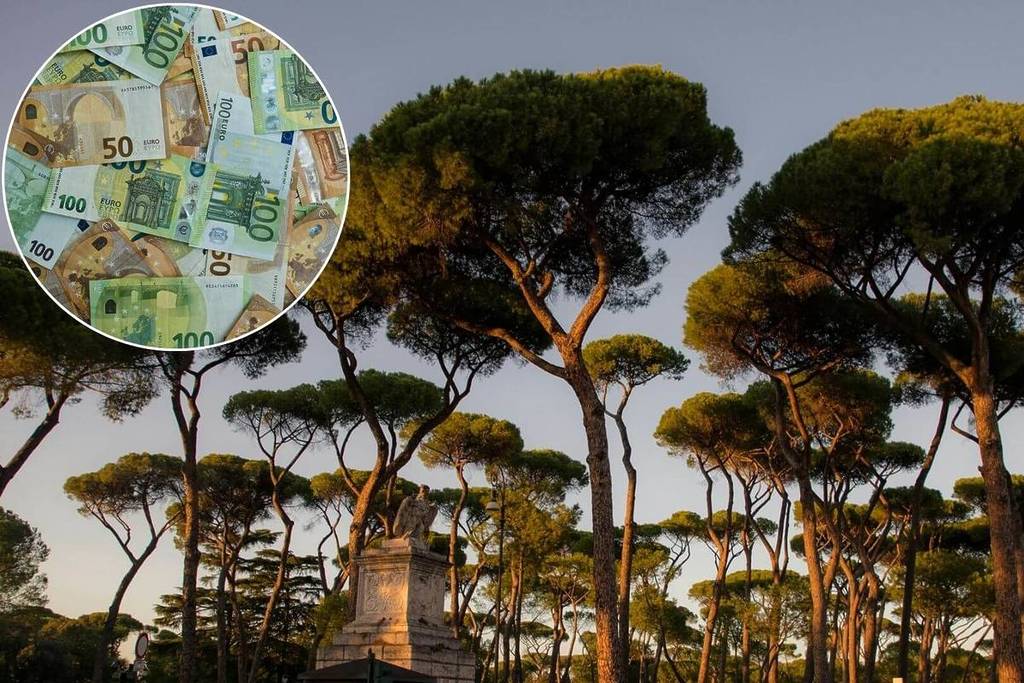
 maydays/ Getty images
But Pinciano is not just a number on an F24 form. It is one of the most refined and charming areas of Rome, officially established in 1921. If you decide to take a stroll around it—perhaps to dream a little in front of some period villas—know that you are in an open-air museum.
Here’s what you absolutely cannot miss if you’re passing through:
- Villa Borghese: the green heart of Rome is technically here. You can stroll along the avenues that have hosted nobles and artists for centuries.
- Galleria Borghese: one of the most important museums in the world. If you want to see what true wealth (artistic wealth, that is) looks like, Bernini and Caravaggio await you.
- Eclectic architecture: the neighborhood is a mix of neo-baroque, rationalist, and early 20th-century stately villas that look like they came out of a high-class movie.
- Via Pinciana and Via Paisiello: streets where embassies and historic buildings define an urban landscape that is unmatched in its composure and prestige.
The Divide: how Rome is divided between rich and poor
This is the crux of the matter. Rome is a city where income is not distributed evenly between the center and the suburbs. It is more as if there were a clear dividing line, and on one side of the border people earn almost three times as much as on the other.
In Municipio I (historic center and Prati), the average declared income is around €37-39,000. In Municipality II (Parioli, Flaminio, Salario, Trieste, Nomentano, Pinciano), it rises to €41-43 thousand. These figures already tell the story of a wealthy Rome, where teachers, professionals, and luxury retailers live comfortably.
Then you go down to Municipality VI (Tor Bella Monaca, Ponte di Nona, Borghesiana, Torre Maura) and the average income plummets to €17-18,000, with even lower peaks in some postcodes. It is not a question of economic sector. It is not a question of industry. It is the result of decades of urban planning choices, waves of migration, and public investment concentrated in certain areas.
The gap is so wide that those who live in Pinciano and those who live in Labaro (average income around €22,000) live two economically incompatible lives.
Even within the same northern area, the picture is complicated: Vigna Clara-Tor di Quinto-Ponte Milvio-Fleming stands at just over €50,000, while Labaro does not reach €22,000.
A divided city: Rome’s poorest neighborhoods
While Pinciano celebrates its €71,916, there is another Rome that whispers very different figures. It is the Rome that cannot make ends meet. Not the Rome that complains about restaurant prices. A Rome where economic choices are all negative, where household budgets are always in the red.
The neighborhood with the lowest average income is Cecchignola/Acilia Nord/Casal Palocco (postal code 00119), with a declared average income of only €16,611 per year.
Next, still at the bottom of the ranking, are Labaro with €22,000, Giustiniana with €27,000, and Prima Porta with €33,000.
If you think that northern Rome is all wealthy, you will discover that this is not exactly the case. The northwestern quadrant, beyond areas such as Vigna Clara and Fleming, conceals areas with significantly lower incomes, neighborhoods that feel forgotten.
In the VI Municipality, the situation is even more complicated: Tor Bella Monaca, Torre Angela, and Borghesiana have average incomes between €17,000 and €19,000. These are the numbers behind social problems, higher-than-average youth unemployment, lower levels of education, and a concentration of families at risk of poverty.
In conclusion, the Withub map not only tells us how much Romans earn, but also tells us about a fragmented city.
Have you checked the location of your postal code yet? Do you think your area deserves more, or do the figures reflect what you see every day when you leave your home?