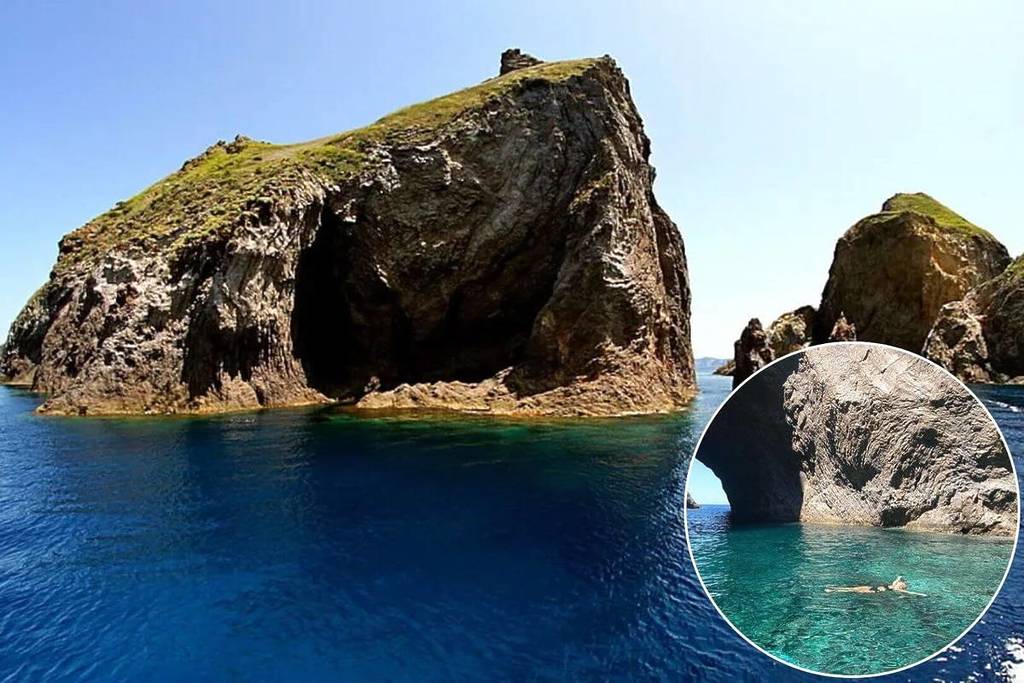

There is a place in Lazio that remains wild, where cars are a rarity and the blue of the water takes on shades you’d expect to see only in the Greek Cyclades. It’s called Palmarola, it’s less than two hours from Rome, and when you first spot it from the sea, you’ll find it hard to believe you’re still in Italy.
Caribbean-like waters, sheer volcanic cliffs, caves where Barbary pirates once hid, and dwellings carved by hand into the rock: this tiny strip of land in the Pontine Islands —a nature reserve protected since 1998 and part of the Circeo National Park —is one of the most extraordinary and least-visited destinations in the entire Mediterranean.
If you’re looking for a day trip from Rome that will truly surprise you, look no further.
Palmarola, the island near Rome that transports you to the Greek Cyclades
For Romans who seek an unspoiled stretch of sea every summer without flying elsewhere, Palmarola is one of those places that, once discovered, become a secret to be jealously guarded. Yet there it is, about 10 kilometers west of Ponza, reachable by boat in less than an hour from the Lazio coast.
The nickname “Little Greece” didn’t spring from the imagination of some tourist office. Anyone approaching this strip of volcanic rock by boat is overwhelmed by a landscape they didn’t expect: vertical cliffs of pure white tuff, bright green Mediterranean scrub, and a sea with shades of Caribbean blue that seem almost unreal.
A visual contrast that closely resembles the rock formations of the Cyclades, but with a fiercer spirit. The famous oceanographer Jacques Cousteau —according to a widely reported quote passed down by local tradition, and confirmed by other explorers such as Folco Quilici —called it “the most beautiful island in the Mediterranean.” It’s hard to disagree with him.
Cave Houses and No Hotels: A Unique Experience on the Island
Palmarola has no hotels, no paved roads, and no regular ferry service. Its status as a nature reserve has kept real estate speculation at bay and, above all, mass tourism.
So where do visitors stay? You should know that during the 18th century, fishermen and farmers from Ponza began carving into the tuff rock above Cala del Porto to protect themselves from pirates and inclement weather. This is how the Cave Houses came to be: spartan rural dwellings, literally carved into the rock face, recognizable by their small doors and windows painted white and blue. Some of them are open to tourists.
Staying in one of these caves means giving up all modern comforts in exchange for falling asleep to the symphony of the waves just a few meters away. It’s an experience hard to find anywhere else in Italy.
By boat around the island: 5 things to see if you visit Palmarola
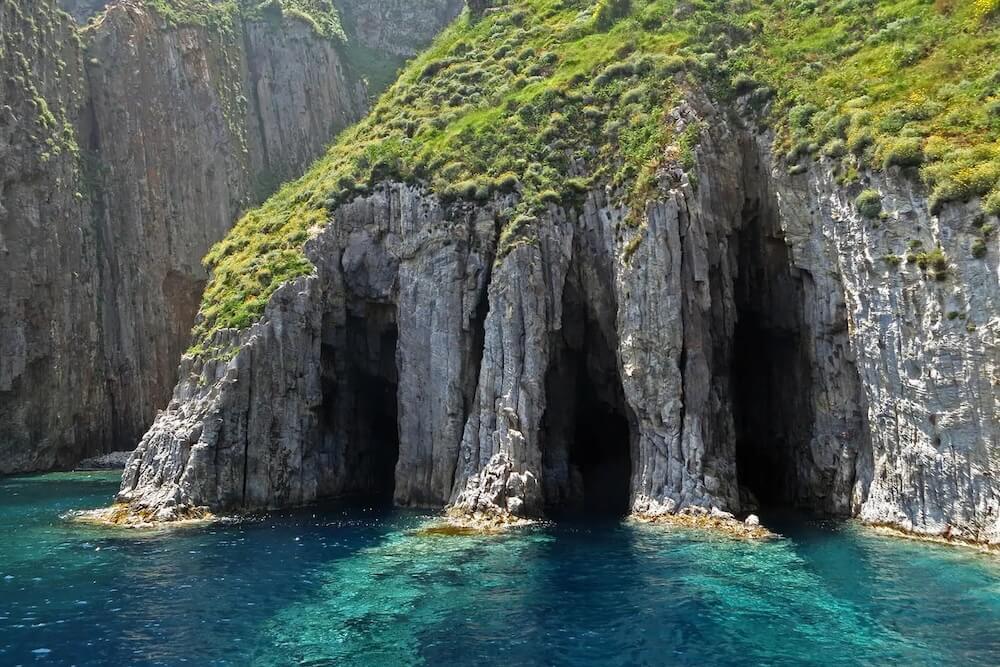
You don’t explore Palmarola on foot. You slowly sail along its coast from the sea, and every bend in the coastline holds something new. Here are the five must-see spots during your circumnavigation of the island:
1. Cala del Porto: the island’s only safe harbor, sheltered by the Faraglione di San Silverio. Boats at anchor seem to float in the air thanks to the crystal-clear water. Here you’ll also find the legendary O’ Francese restaurant, the island’s sole commercial establishment: fish caught that very morning, an informal and unique atmosphere.
2. The Cathedral: in the northern part of the island, a wall of black volcanic rock with basalt columns smoothed by centuries of weathering. Its appearance is strikingly reminiscent of the naves of a Gothic cathedral. Snorkeling at its base induces something akin to aesthetic vertigo.
3. Cala Brigantina: a cove almost invisible from the open sea that served as a refuge for Barbary pirate ships in the Middle Ages. Today it is an emerald-green natural pool, with Scoglio Suvace standing guard (so named in the Ponzese dialect for its sole-like shape).
4. The Faraglioni di Mezzogiorno: a complex of monumental rocks featuring a natural arch about 20 meters high. Small boats can pass through it: an unforgettable experience. Nearby lies the Grotta del Gatto, with a freshwater spring inside, accessible only by kayak or small boat.
5. The Grotte delle Galere: rocks mottled with black on ochre due to the presence of obsidian, the purest volcanic glass that, even in prehistoric times, led the peoples of Circeo to reach the island on rafts to craft weapons and tools from it.
How to get to Palmarola from Rome: everything you need to know
By car + ferry
- Via Formia (recommended route): about 1 hour 30 minutes from Rome by car via the A1/A2 to Formia, then ferry or hydrofoil to Ponza (1 hour 30 minutes by ferry, about 1 hour by hydrofoil). From Ponza, take the boat to Palmarola, a 40- to 50-minute ride.
- Via Anzio: alternative route from the A12 or Via Pontina, ferry to Ponza taking about 2 hours and 15 minutes.
By train + ferry
- From Roma Termini, take the Intercity train to Formia-Gaeta (approx. 1 hour 20 minutes). The port is a 15-minute walk from the station or accessible by taxi.
- From Anzio, the regional train from Roma Termini to Anzio takes about 1 hour.