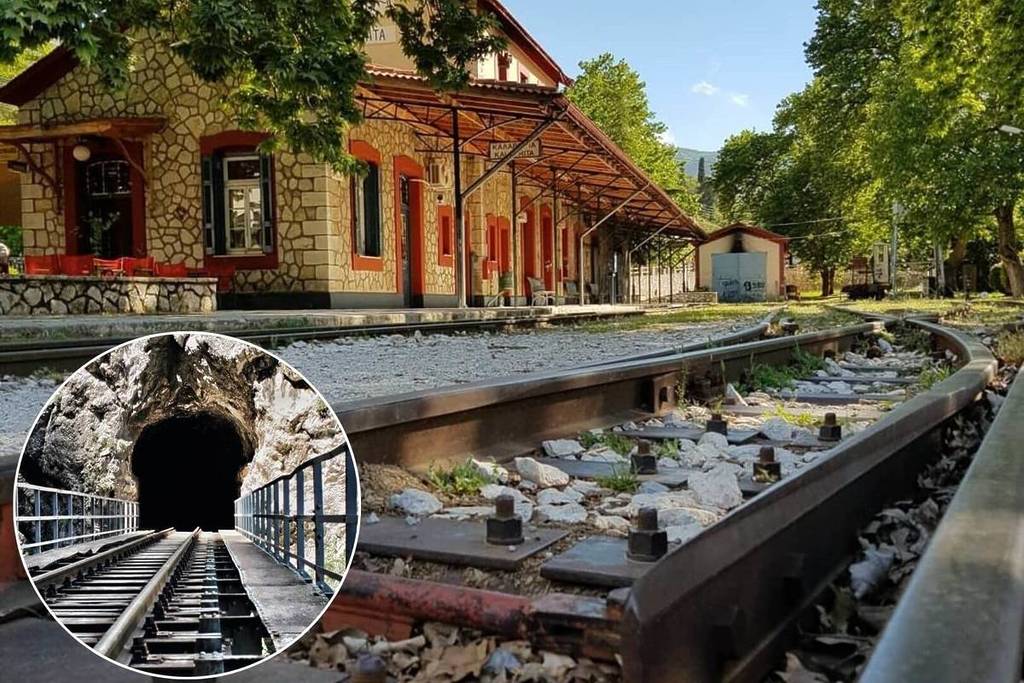

There is a train that attracts travelers from all over the world every year: it is not famous for its speed or luxury, but for the way it moves—literally clinging to the rock with a cogwheel. It covers 22 kilometers in about an hour, climbs 700 meters in elevation, and passes through wild canyons, tunnels carved into solid rock, and forests that look like something out of a movie.
It costs €9.50 and is located in the Peloponnese, Greece: it’sthe Odontotos, the Diakopto–Kalavryta railway.
The detail that changes everything
If you’re in Rome and planning your summer vacation but the idea of Mykonos or Santorini bores you just hearing about it, this is the right article. The Odontotos isn’t one of those “experiences” hyped up by travel bloggers: it’s a historic railway inaugurated in 1896, with an extremely narrow gauge— 750 millimeters, the narrowest in the world still in operation for commercial service.
The train operates thanks to a rack-and-pinion system: a third toothed rail in the center of the tracks onto which the train “clings” to climb the steepest sections, with a maximum gradient of 1.75 percent. A technology that is rarely used today, and which has 130 years of history behind it here.
The story: an almost stubborn project
In 1889, when Greece was a young and fragile nation, Prime Minister Charilaos Trikoupis decided to build a railway connecting the village of Kalavryta —at an altitude of 750 meters, the gateway to the ski resorts of Mount Chelmos (2,355 m a.s.l.)—to the coast of the Gulf of Corinth. The project was entrusted to Greek-French engineers, with a key contribution from the Italians, who brought their extensive experience with Alpine railways.
Construction took nearly seven years. The inauguration took place on March 10, 1896. It was immediately clear that this was something extraordinary: an electrified railway in an era when 90% of trains still ran on steam, powered by hydroelectric energy from the Vouraikos River.
A detail that Romans, with their millennia-old history of engineering, appreciate better than anyone else: a collaborative effort between Italy, France, and Greece that anticipated the spirit of the European Union by nearly a century.
Rack-and-pinion technology: a forgotten masterpiece
From km 3.1 to 16.9, the Odontotos uses a rack-and-pinion system: a third central toothed rail onto which the train engages to climb gradients that would be impassable for any other train.
Tunnels, canyons, and pure engineering
The route along the Diakopto–Kalavryta railway is dotted with engineering masterpieces: massive retaining walls on either side, tunnels carved into the bedrock with one side open toward the valley floor, and the Vouraikos Canyon—wild gorges traversed by the river, waterfalls, and vertical rock faces. One of the most spectacular landscapes in all of Greece, accessible only by this train or on foot.
What you see from the train: the stunning landscapes traversed by the Odontotos
Kalavryta isn’t just the final stop: it’s a small town with a rich and painful history. It’s worth stopping to see:
- The Caves of the Lakes (Spilaio ton Limnon), near Kleitoria: a caving route with underground streams and small waterfalls, among the most picturesque in Greece
- The Monastery of Agia Lavra (10th century): it was here in 1821 that the motto Eleftheria I Thanatos — Freedom or Death — was coined, sparking the Greek War of Independence against the Ottomans
- The Kalavryta Massacre Memorial: one of the gravest crimes committed by the Nazi army in Greece during World War II, now commemorated in a sober and necessary museum
⚠️ Warning: the railway is suspended
Update May 2026: The Odontotos has been officially suspended since March 12, 2026, for safety reasons, after landslides and rockfalls on Mount Chelmos damaged the line. The OSE (infrastructure manager) has announced an indefinite closure pending in-depth geological studies, and the European Parliament has already raised the issue at the institutional level.
In April 2026, however, preparatory work for the reopening began: clearing of at-risk areas, geotechnical surveys, and the installation of seismic and meteorological sensors along the line. The reopening is currently being actively planned.
Keep an eye on the official website hellenictrain.gr for real-time updates, and if you’re already planning your Greek vacation for next summer, this is the kind of experience worth putting on your wish list.
How to get to the Diakopto–Kalavryta railway from Rome
✈️ By plane + train (recommended)
For those departing from Rome, this is probably the most unique destination reachable with a two-hour flight. From Fiumicino (FCO) or Ciampino (CIA), you can fly direct to Athens (ATH) with Aegean, Ryanair, or ITA, with prices starting at around €55–80 round-trip during the off-season. From Athens, take the intercity train to Diakopto (about 2.5 hours; departure station: Athens Larissa). The total cost of the Rome–Diakopto trip using this itinerary starts at around €55–170 per person.
🚗 By car + ferry (for the more adventurous)
For Romans accustomed to the Adriatic, this option has all the flavor of a true adventure. From Rome, take the A1 toward Brindisi, then a ferry to Patras (companies like Grimaldi Lines or Superfast Ferries, about a 16–20-hour crossing). From Patras, Diakopto is just a 40-minute drive along the coast of the Gulf of Corinth. A perfect option if you want to explore the Peloponnese with more freedom and perhaps combine Kalavryta with Olympia, Nafplio, or Monemvasia for a Greek vacation off the beaten path.