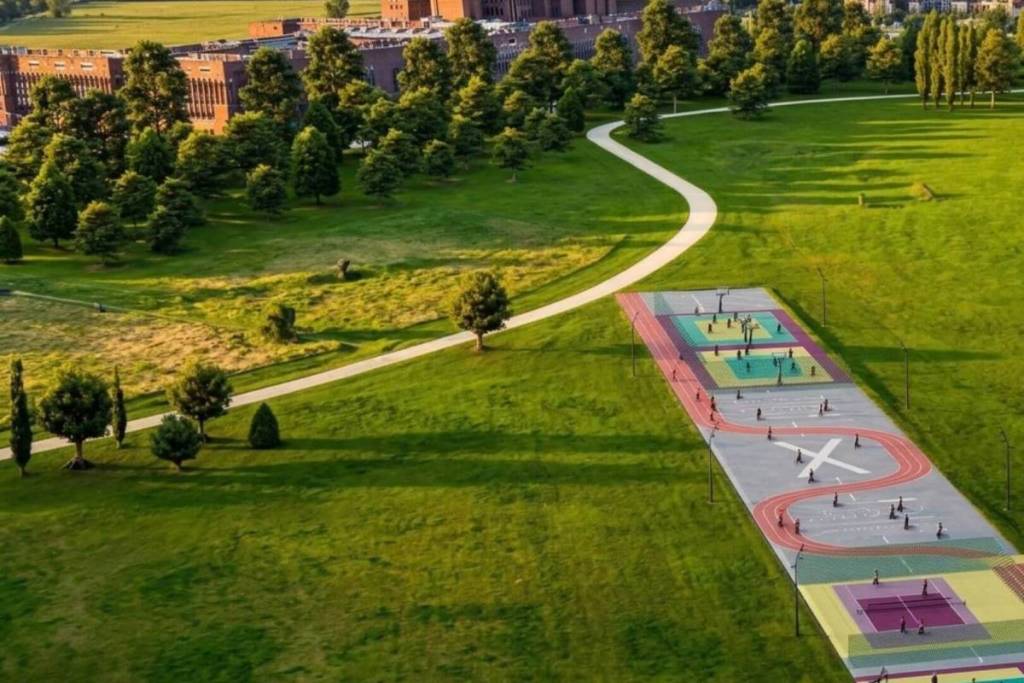

For decades, planes took off and landed on this runway. Today, people shoot hoops, do Pilates, and ride elliptical trainers there—without a membership and without paying a single euro.
Starting September 22, the runway of Italy’s first airport—over 350 meters long and 23 meters wide—has become the vast playground of Centocelle Park: an open-air gym with courts and equipment available for free public use.
Free Sports in East Rome: What You’ll Find on the Old Runway, Field by Field
The track at Centocelle Park has been repaved with permeable materials and divided by color, with each color corresponding to a specific activity. If you’re working out on your own, there are two fitness areas equipped with rowing machines, ellipticals, and equipment for shoulders and chest.
If Saturdays mean team sports for you, you’ll find one basketball court, two street basketball courts, one volleyball court, and two pickleball courts.
For those who prefer a slower pace, there are two Pilates areas, one for yoga, and four ping-pong tables.
Even the field where the neighborhood’s foreign communities used to play cricket has been renovated and is now part of the park.
The new green square on Via Casilina: water features and 600 trees
Where there used to be a parking lot, there is now a square covering about 4,500 square meters. It features benches, flower beds, and water features that provide a cooling respite in the summer using recycled water. The parking lot has been moved a short distance away, away from the park’s avenues.
About 600 trees have been planted throughout the area, including oaks, plane trees, mulberry trees, Judas trees, and holm oaks.
The History of the Pratone di Centocelle: From Wilbur Wright’s Flights to Italy’s First Airport
The real surprise, however, is the history of this field, which the Romans called the Pratone di Centocelle. In April 1909, the American Wilbur Wright—a pioneer of powered flight alongside his brother Orville—made 67 flights here over the course of eleven days. One of his passengers was Mario Calderara, a young Navy officer who learned to fly right here and, a few months later, became Italy’s first licensed pilot.
This is where Italy’s first airport was built, and in 1920, the Rome-Tokyo flight organized by D’Annunzio took off from here.
After the wartime bombings and its decommissioning in the late 1950s, the 1965 zoning plan designated the area for office buildings. Three Roman villas hidden underground put a stop to all that: in 1992, the site was placed under archaeological protection, and in 1995, the decision was made to turn it into a park.
Decades followed of projects that never got off the ground, illegal car scrapyards on Viale Togliatti, and neighborhood committees that never gave up. For the president of Municipality V, Mauro Caliste, the inauguration was “a historic day.”
Baciocchina, Via Papiria, and the Roman villas: upcoming projects in the park
The park isn’t finished yet, and it’s only fair to say so. In the coming weeks, the Baciocchina—the former gas station converted into the park’s visitor center, complete with a café, study room, and coworking spaces—is set to open.
Work is also planned on the Don Bosco side, which will open the park to residents living between Cinecittà and Torre Spaccata.
Work is underway on the new entrance off Via Papiria and on the restoration of the “tagliata,” and by 2027, the number of entrances is expected to reach nine.
The most fascinating question remains: the three Roman villas are still buried underground, and committees have long been calling for them to be unearthed.
In the meantime, the track is there, free and open to everyone. If the weather holds up, the first weekend in October is the perfect time to try it out: grab your sneakers and a water bottle, and Via Casilina will feel like a whole new street.