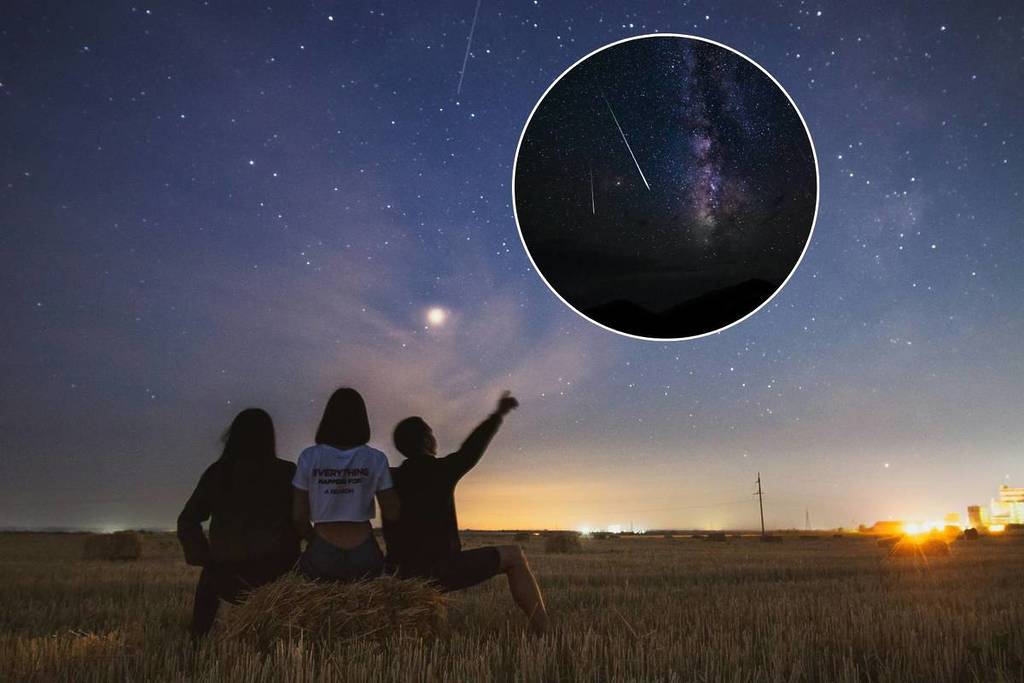
Ah how beautiful the night of St. Lawrence, at the beach admiring the “shooting stars.” It’s true: it’s not summer anymore! Even in autumn, however, it is possible to make a wish, looking at the sky. Mark this date in your diary: October 21, 2025 will see the peak of the Orionid meteor shower.
The shooting stars of October

We are talking about a highly anticipated astronomical event that will be particularly favorable for observation due to its coincidence with the new moon. This lunar phase, characterized by the absence of moonlight, will make the sky as dark as possible, creating ideal conditions for admiring the extremely fast and bright shooting stars caused by the debris of comet 1P/Halley-the only one that can be seen with the naked eye. This phenomenon is caused by Earth passing through the debris trail left by the comet.
Good to know: a comet is a small celestial body consisting of ice, dust and rocks that orbits the Sun. Comet Halley will return to the inner solar system in 2061; a person may only see it twice in a lifetime.
The Orionids are known for their rapidity and brilliance, and are a fascinating spectacle visible to the naked eye. The radiant, that is, the point from which these meteors appear to originate, is in the constellation Orion, hence the name Orionids. However, those with binoculars or a telescope will also be able to take advantage of the dark night to observe fainter objects in the cosmos, such as distant galaxies and bright nebulae, which are often invisible in moonlight.
Thus, the evening of October 21, 2025 will be perfect for enjoying this natural spectacle in the quiet of a particularly clear and dark night sky. Remember, that the ideal observing location is a dimly (artificially) lit area.
The meteors appear as very fast light trails, with a speed of about 66 kilometers per second. The number of observable meteors in the peak depends on the presence of various “trails” of Halley’s comet accumulated in Earth’s orbit over the years.