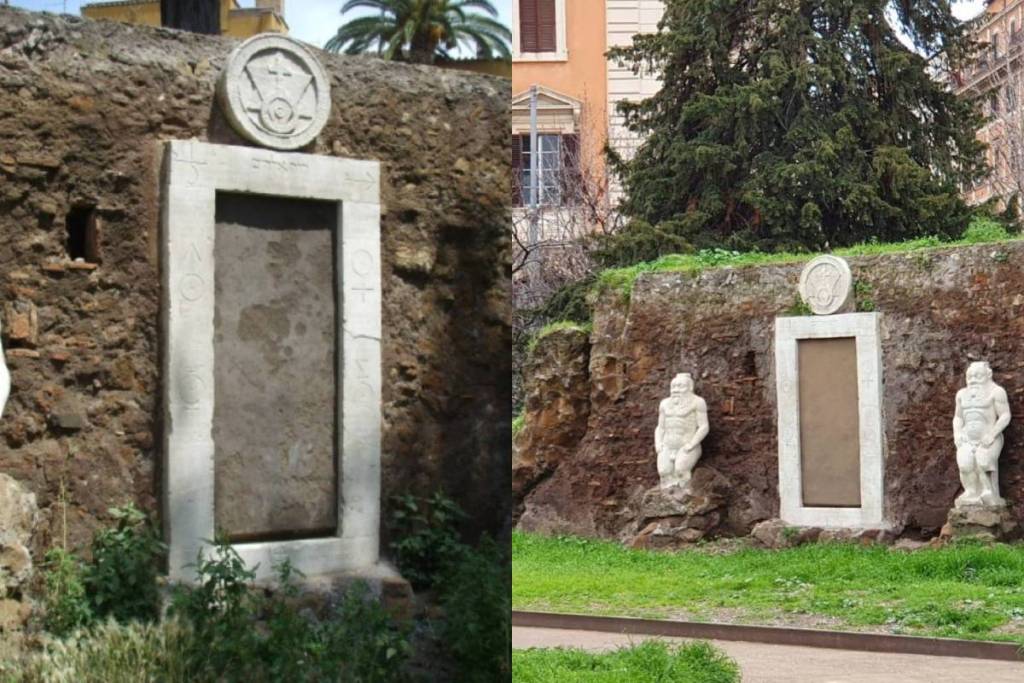

In the vibrant, multi-ethnic heart of Rome, nestled among the lush gardens of Piazza Vittorio Emanuele II, lies one of the capital’s most fascinating and mysterious historical landmarks: the Alchemical Gate, also known as the Magic Gate. This monument, often overlooked by hurried passersby, serves as a portal suspended between history, myth, and the ancient occult sciences.
The Origins and the Alchemical Circle
Originally, the artifact was not isolated as we see it today, but was one of the five entrance gates to Villa Palombara, the sumptuous 17th-century residence of Marquis Massimiliano Palombara (1614–1680). The nobleman, a fervent scholar of esotericism, was a prominent member of the intellectual and alchemical circle that gathered in Rome around the figure of the former Queen Christina of Sweden.
The heart of the mystery surrounding the door revolves around the legend of an enigmatic pilgrim. Welcomed by the marquis into the laboratories of his villa, the mysterious guest attempted the arduous feat of transforming waste into gold. According to the myth, one morning the pilgrim vanished into thin air as he passed through the magical door, leaving behind only a speck of gold and a manuscript filled with indecipherable formulas. Much of esoteric historiography identifies this traveler with the famous 17th-century physician and alchemist Francesco Giuseppe Borri, who historically found refuge on the estates of the Marquis of Palombara (Source: Gabriele, Mino. “La Porta Magica di Roma: studio storico-alchemico,” Olschki).

In an attempt to find an initiate capable of deciphering those enigmas, the marquis decided to have the complex symbols and mysterious maxims left by his guest engraved directly onto the stone of the cornice, hoping that someone might one day solve them.
Symbols, Phases, and Guardians
The architecture of the portal is a veritable conceptual map of alchemy. The pediment features a seal representing the intersection of the Sun and gold. A precise scheme of correspondences between celestial bodies and metals winds along the cornices—for example, Saturn (lead) and Jupiter (tin). Beneath the planetary effigies are cryptic inscriptions.
Today, standing as “guardians” on either side of the gate are two eerie statues of the Egyptian god Bes ( a symbol of joy and fertility). These figures were not originally part of Villa Palombara: they were discovered on the Quirinal Hill and placed in Piazza Vittorio only at the end of the 19th century, during the major construction work for the development of the modern neighborhood.
The Philosopher’s Stone
The instructions engraved on the door are said to summarize the creation of the mythical Philosopher’s Stone. Known to today’s general public thanks to the famous Harry Potter fantasy saga , the Philosopher’s Stone was in reality the supreme and true goal of every alchemist. According to esoteric tradition, this catalyst possessed a threefold, extraordinary power:
- The ability to transform base metals into gold
- The Elixir of Long Life
- Omniscience: The Elevation of the Spirit to Absolute Knowledge
For up-to-date information on the gardens’ opening hours or to book guided tours, please email: info@060608.it.