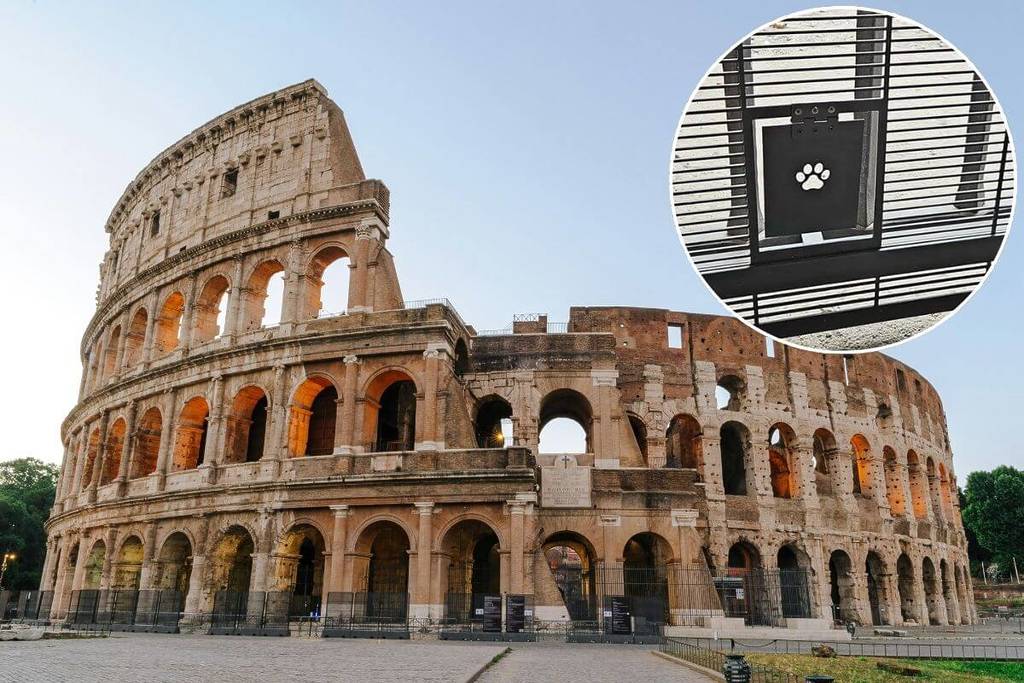

If you walk past the Colosseum, your eyes are probably drawn upwards, captivated by the millennial majesty of the arches that have seen emperors and gladiators pass through.
But if you were to look “down below” for once, right where the mighty railings protecting the world’s most famous monument touch the ground, you would make a discovery that has already gone viral on the web and that you have probably always missed.
There are small openings, little doors finished with the outline of a paw, which represent the exclusive entrance for the real masters of the house: the cats of the Colosseum cat colony.
And yes, among them is the legendary Romeo, a tenant in flesh, bone, and whiskers who roams undisturbed among the remains of the Flavian Amphitheater.
The secret in the grates: why there are mini-doors with paw prints
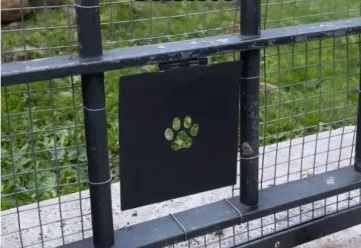
Although thousands of Romans pass by those gates every day, almost no one had ever noticed this charming detail. What you see are actual institutional “cat doors, “ created to allow the cat colony to move freely between the Colosseum, the Roman Forum, and the Palatine Hill, even when the gates are closed to us humans.
These passages are not an ancient invention, but a clever adaptation of the monument’s protective structures. While the Colosseum is almost two thousand years old, the railings surrounding it were installed in the 19th century to protect the site. It is precisely in these “modern” structures that the passages for the cats of the colony have been created.
If you wait patiently, you might see one emerge with the air of someone who knows perfectly well that they live in the most envied residence on the planet.
Romeo: a myth born from a stroke of genius (all Italian)
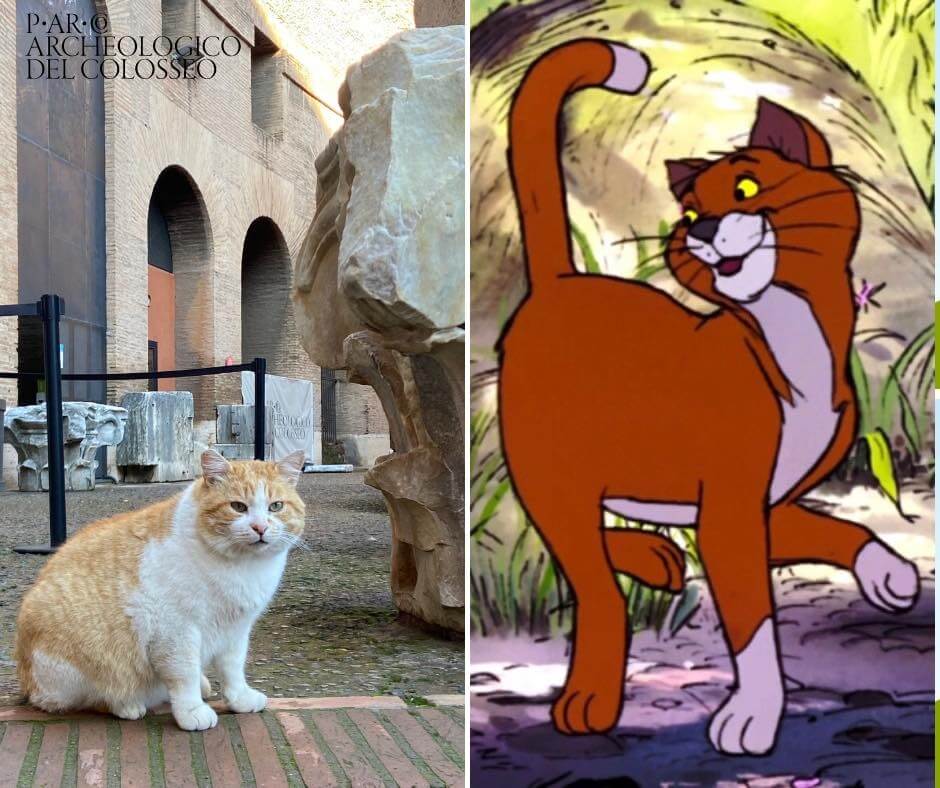
But who is Romeo really? If you’re thinking of the protagonist of The Aristocats, you should know that his “Romanity” is an extraordinary gift of Italian dubbing.
In the original Disney version, the cat is called Thomas O’Malley and is a stray with Irish roots. It was only thanks to a brilliant intuition in the 1970 Italian version that he became ‘our’ Romeo, er mejo gatto der Colosseo(the best cat in the Colosseum).
This change of identity has worked so well that today, for us, it is impossible to imagine the Colosseum without thinking of him.
What was once a fictional character has become the symbol of the real colony: a tribute to that mix of elegance and cheekiness that only cats raised among monuments can have. Calling the alpha male of the current colony “Romeo” is not just a game for tourists, but the recognition of a legend that is now part of the soul of Rome.
Where to find the Colosseum’s little doors to see Romeo
If you want to experience the thrill of finding these secret entrances, just walk aroundthe Flavian Amphitheater from the outside, along the railings. Look carefully at the bottom of the metal grates: you will notice small rectangles cut out with extreme care at ground level.
- Where to look: the passages are most visible along the perimeter facing the Arch of Constantine and the entrance to the Palatine Hill.
- The best time to visit is at sunset, when the crowds thin out and the cats begin their “patrols.”
- Total respect: remember that you are a guest in their thousand-year-old garden. Do not call them insistently and do not try to lure them with unsuitable food.
Finding these little doors is a way to rediscover a Rome that does not shout, but whispers stories of care and coexistence among its most famous stones. The presence of Romeo and his colony makes the Colosseum a “living” monument, capable of combining the majesty of history with the tenderness of a life that flows peacefully among the remains of the Empire.