
Anyone who’s waited for a bus at Piazza dei Cinquecento on a July afternoon knows that feeling: the asphalt radiating heat back at you, no shade at all, and breaking a sweat even before you step onto the bus. It’s right there, in the city’s hottest, most concrete-covered square, that one of the most intriguing new developments of the Roman summer might be coming .
It’s called the Bioclimatic Tree and is, in effect, a natural air conditioner: a structure that promises to lower temperatures by up to 10 degrees without consuming a single watt. The City Council is considering it for the plaza in front of Termini Station, next to the new entrances to Metro Line B.
How it works (and why it’s not just a simple misting system)
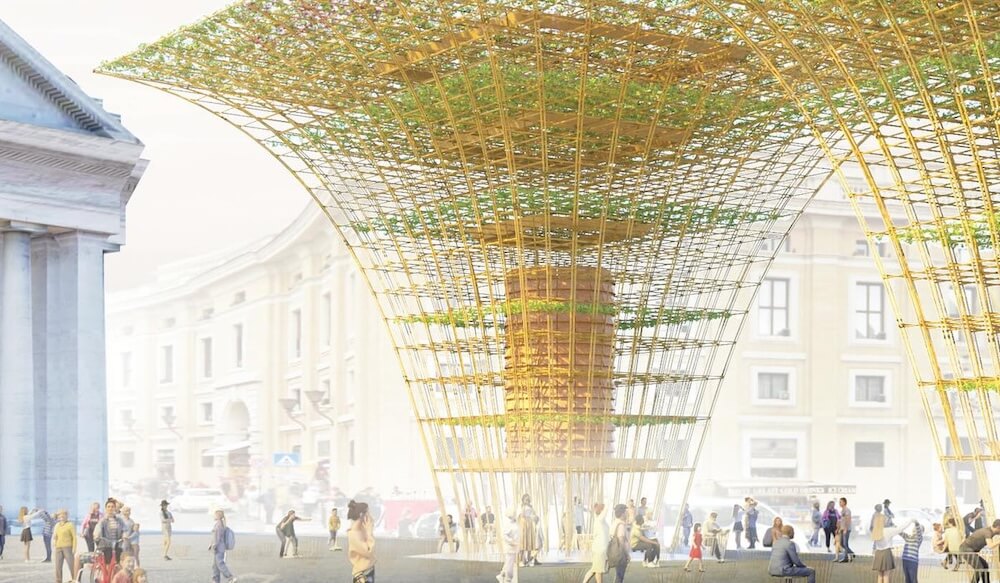
The principle is ancient and is called adiabatic cooling. At the heart of the structure is a cylinder made of recycled brick that is kept constantly moist: the water evaporates, absorbs heat from the air, and releases a cooler flow that is pushed downward.
No motors, no refrigerants, no electricity. The same principle that cooled the palacesof ancient Egypt and the Zisa Fortress in Palermo, reimagined for the modern age.
Why Piazza dei Cinquecento, of all places?
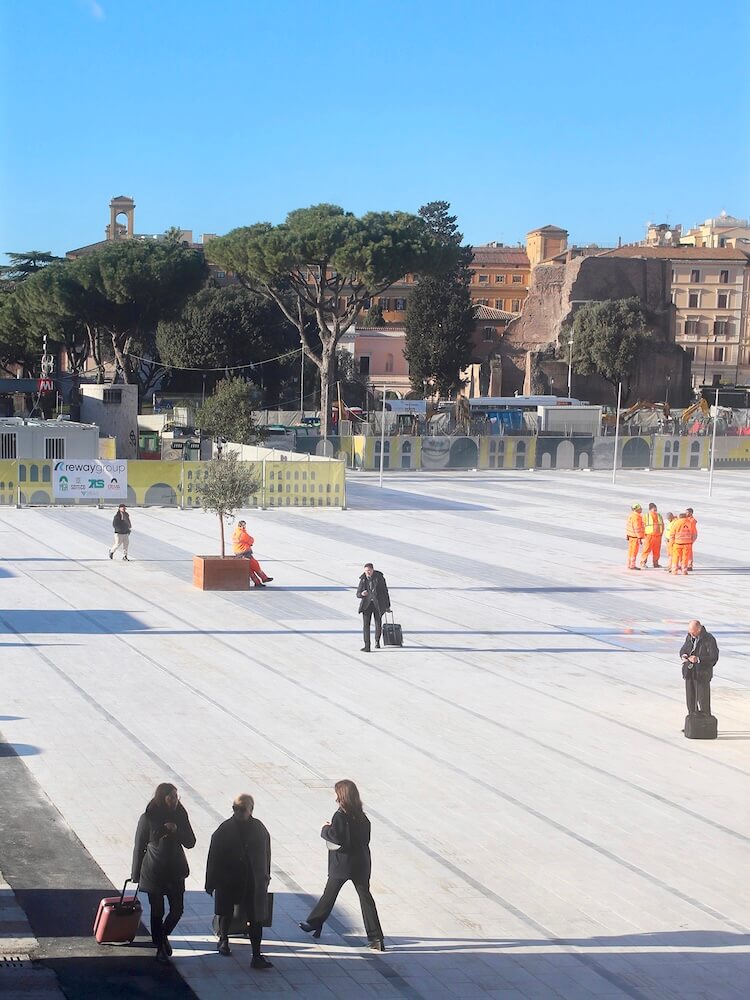
The choice of location is no accident. The idea was originally conceived for St. Peter’s Square, but it’s in front of Termini that it truly makes sense: that open space is one of the capital’s most intense heat islands, all light-colored stone and asphalt, without a shred of shade.
To be honest, the square’s redevelopment did call for some greenery. But tall trees cannot be planted on top of the Metro B slab, and the urban forest promised for the area has been scaled back along the way anyway. That’s why there—where real tree canopies would be needed—they’re considering an artificial tree that tries to do their job.
A 500,000-euro project (which still needs to be approved)
Here’s the part that anyone who lives in Rome and is familiar with the endless bureaucratic process of city projects really wants to know. The Bioclimatic Tree is an innovative project promoted by Wittfrida Mitterer, director of the Master’s program in Bioarchitecture at LUMSA, in collaboration with Transsolar’s climate engineering team and the German firm Haas Cook Zemmrich.
It’s not a done deal yet: the City Council must complete technical and economic feasibility studies, with an estimated cost of around 500,000 euros. And those 10 degrees cooler refer to the microclimate around the structure, not the entire square being cooled all at once.
Sabrina Alfonsi, the councilor for the Environment, has described the project as “innovative and appealing.” For now, it remains a prototype, but it’s among the most talked-about news stories in Rome these days, because it raises a question that’s bound to come up every summer: how do you design a square in the age of 40-degree heat?