
On the other side of the world, aerospace engineers are testing a revolution that could radically transform the skies: a gigantic “flying wing” capable of traveling at nearly 1,000 km/h, carrying the equivalent of the population of an entire Roman city block.
The giant of the skies challenging Airbus and Boeing
The project is being developed by the Chinese Aerodynamic Research and Development Center (CARDC). The figures, reported by the South China Morning Post, paint a picture of an unprecedented behemoth: 43 meters long and with a wingspan of 85 meters—dimensions that surpass even the massive Airbus A380. It is expected to have a cruising speed of 987 km/h, well above the current average. But the real innovation isn’t just its size—it’s its shape.
The chosen design is called Blended Wing Body ( BWB). Essentially, the aircraft has no distinct central fuselage: the cabin and wing surfaces merge into a single, enormous aerodynamic structure. This configuration would revolutionize the in-flight experience. The cabin’s enormous width would make it possible to do away with the classic three rows of seats divided by narrow aisles. The interior would be reorganized into actual lounge areas, family-friendly zones, and separate cabins.
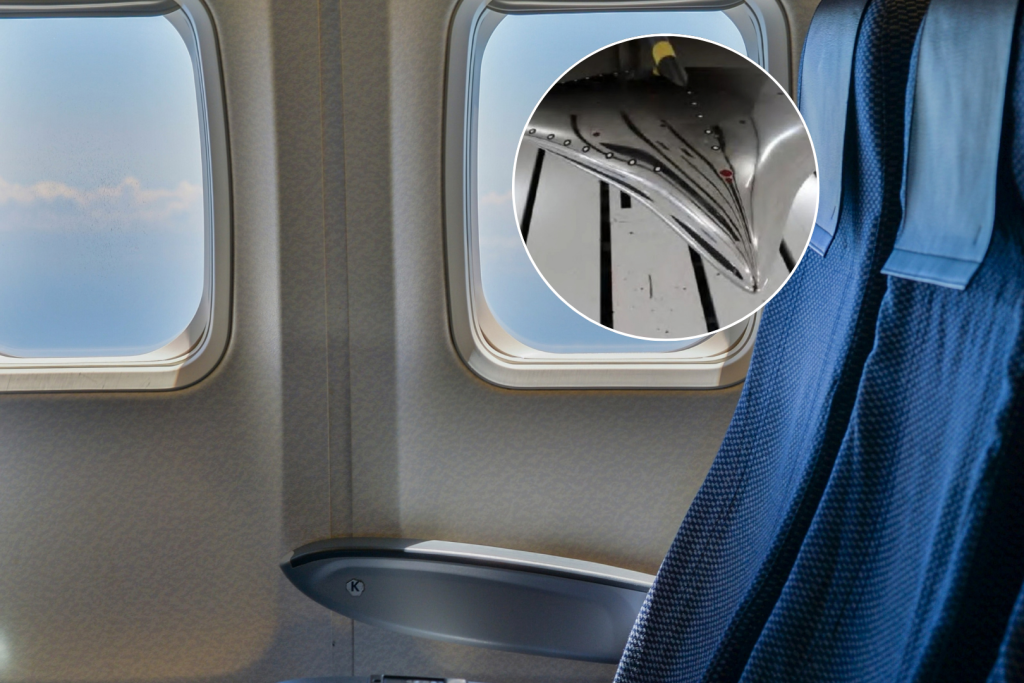
However, there is a spatial trade-off: the vast majority of the 800 passengers would travel in the central sections, far removed from the outer walls. The engineers’ solution? Replacing plastic and glass with technology. The design calls for digital windows: ultra-high-definition screens connected to external cameras, capable of projecting the surrounding landscape in real time to recreate the sensation of flight even in the center of the cabin.
The bottleneck: why airports are the real limitations
An aircraft with an 85-meter wingspan is currently structurally incompatible with nearly all airports. To allow it to land and maneuver, airports like Fiumicino would need to undergo major modifications, including widening taxiways, reconfiguring boarding gates, and building new custom hangars. Added to this are engineering challenges yet to be tested regarding cabin safety and pressurization, as reported by Leggo.
For now, this behemoth remains an ambitious test bed for Beijing’s long-term plan, which is proceeding in parallel with the C929 (long-range) and future supersonic cargo aircraft.