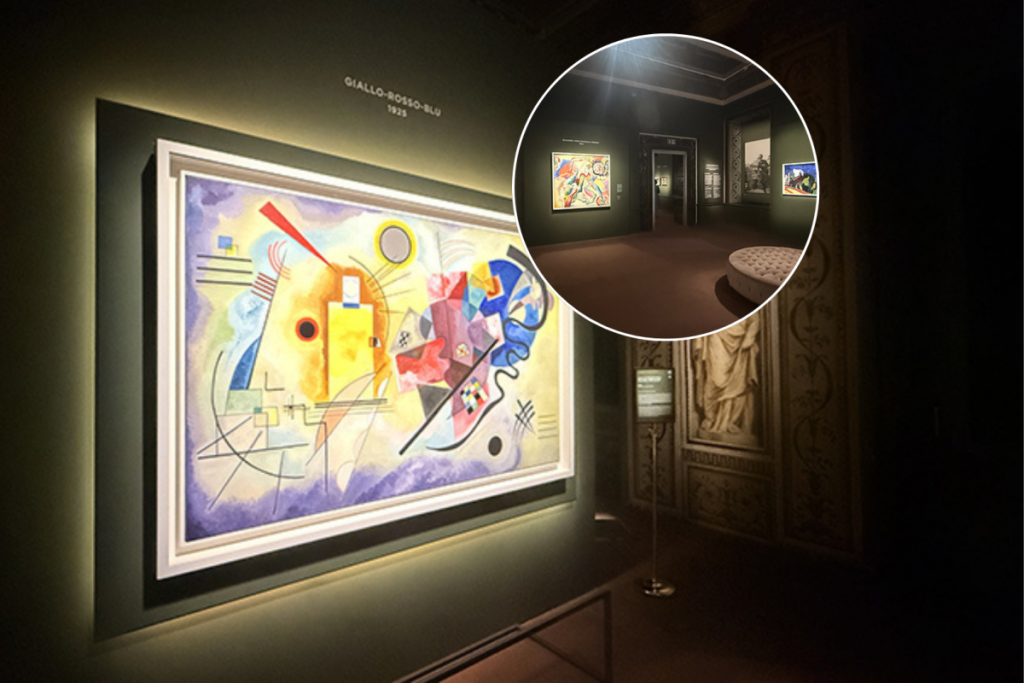

Rome has been waiting for this moment for more than twenty-five years. Palazzo Bonaparte in Piazza Venezia opens its doors to an exhibition that is unlikely to be repeated: more than seventy works by Wassily Kandinsky, most of which come from the Centre Pompidou in Paris—the museum that houses the world’s most comprehensive and significant collection of his works—are making a stop in the capital at a time that is anything but coincidental. The Parisian institution is preparing for a long closure for restoration, and Rome thus becomes the leading international destination for rediscovering the Russian master’s work.
The exhibition, produced by Arthemisia in collaboration with the Centre Pompidou and curated by Angela Lampe, curator of the modern collections at the Musée national d’art moderne, traces the entire human and artistic journey of Kandinsky (1866–1944): from his law studies in Moscow to his decision, around the age of thirty, to abandon everything for painting; from his early years in Munich and the founding of *Der Blaue Reiter* with Franz Marc in 1911, through his time at the Bauhaus and his final years in Paris, which ended with his death in 1944.
The exhibition is divided into five sections and includes masterpieces such as *Gelb-Rot-Blau* (1925) and *The Black Arch* (1912), works that epitomize the revolutionary shift toward a visual language in which color, form, and line become autonomous emotions—independent of any representation of reality. Alongside the paintings, documents, photographs, and materials from the Bibliothèque Kandinsky offer a glimpse into the artist’s more everyday and private life. An immersive room rounds out the exhibition.
A revelation in the spirit of Gabriele Münter
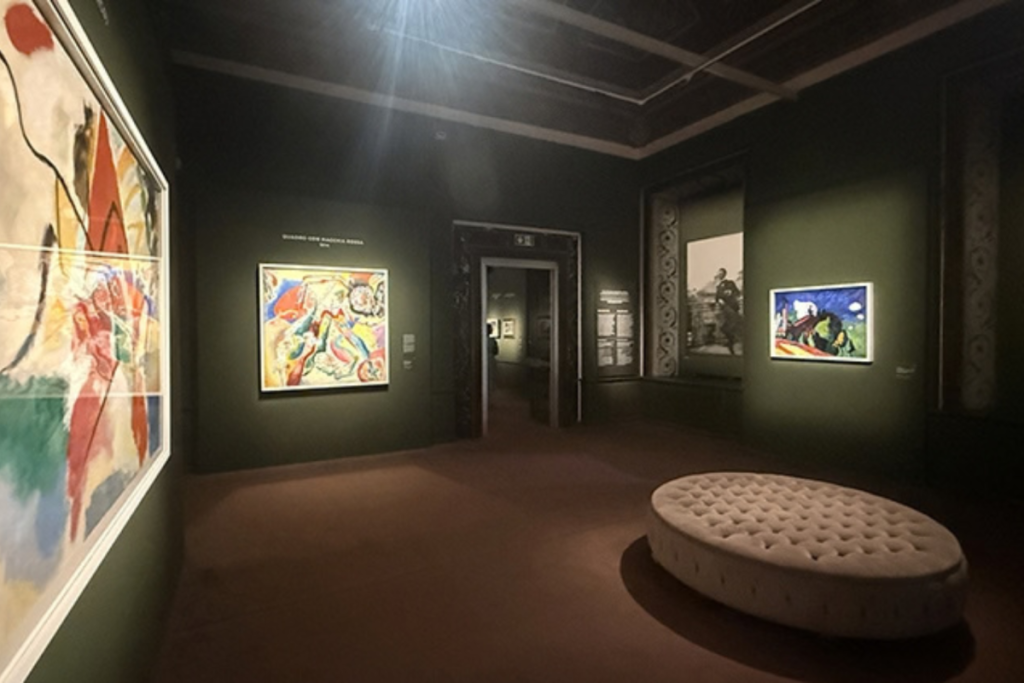
One of the exhibition’s most significant new features is the space dedicated to Gabriele Münter, Kandinsky’s partner for over a decade and a central figure in German Expressionism who remained in the shadows for a long time. Some of her works are being exhibited here for the first time, accompanied by documentation that traces her decisive contribution to the development of the avant-garde. Alongside her, the exhibition also highlights the role of Nina Kandinsky, wife and tireless guardian of her husband’s legacy: it was her generous bequest to the Centre Pompidou that has preserved the master’s immense legacy for us today.
The exhibition is presented under the patronage of the French Embassy in Italy, the Lazio Region, and the City of Rome. The main partner is the Fondazione Terzo Pilastro – Internazionale.