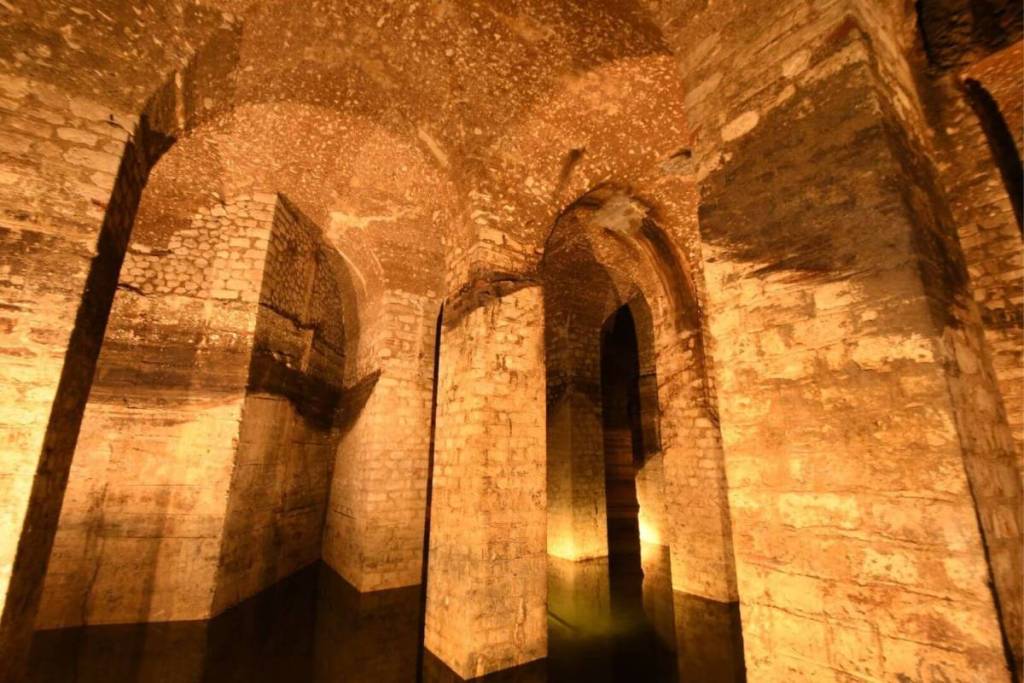

Descending into the Roman Cistern of Formia, on Via della Torre, in the heart of the medieval village of Castellone, is like entering the Basilica Cistern in Istanbul for the first time: the same columns, the same theatrical dim light, the same feeling of having discovered something that shouldn’t be there. The difference is that this one is two hours from Rome, not a three-hour flight, and admission is 5 euros (reduced rate 3).
Inside, the air changes temperature and footsteps begin to echo among the four aisles of pillars: no natural light, only carefully calculated beams of light casting long shadows on the cross vaults.
Recently reopened after extensive restoration, this is the perfect spot if you’re looking for things to see in Formia, things to see in Lazio off the beaten path, or simply a different idea for the weekend.
What makes it truly special
The Cisternone dates back to the 1st century B.C. and is one of the largest Roman cisterns to have survived to this day in nearly intact condition: four naves, pillars, pseudo-cross vaults, over 60 meters in length, and a capacity that exceeded 7,000 cubic meters of water.
Experts also compare it to the Piscina Mirabilis in Miseno, near Naples: the same construction logic, the same ability to withstand the weight of the centuries. A technical kinship between two of the greatest masterpieces of Roman hydraulic engineering still standing today.
The story—the real one
The Cisternone supplied ancient Formiae with water from the springs of S. Maria la Noce, located in the hills above the city. It continued to function—in earnest—until the 20th century: not a ruin to be admired from afar, but an infrastructure that quenched the city’s thirst for nearly two thousand years.
Then it disappeared underground—literally. It was only brought back to light in the early 2000s, after years of excavations to clear away the mud and debris that had accumulated over the centuries.
What to see around the Cisternone to round out your day
Among the day trips near Rome that are worth a full day, adding two stops here is easy. From Castellone, a short walk along the Appian Way takes you to Cicero’s Tomb, one of the best-preserved Roman tombs in the area; those who want to explore a bit further can head to the Gianola and Monte di Scauri Regional Park, a protected area featuring Mediterranean scrub and the ruins of Roman villas overlooking the sea.
And then there’s the sea itself: Vindicio Beach, one of the most highly awarded in the area for the quality of its waters, is the perfect spot to end the day. Foran aperitif, Via Vitruvio is the street for shopping and bars—the place where Formia locals gather in the evening.
How to Get There
From Rome, the Cisternone can be reached in about an hour and a half by train or two hours by car: among the day trips near Rome, it’s one of those that can be organized even at the last minute, as a day trip. The Formia-Gaeta train station is just a few minutes’ walk from the entrance.
Practical Information
📍 Address: Via della Torre, 04023 Formia (LT), Castellone neighborhood, just a short walk from the Church of Sant’Erasmo.
🕒 Tour duration: about 20 minutes, guided.
🎟️ Prices: full price €5, reduced price €3 (combined tickets with other archaeological sites in the city are available).
🎫 Online ticket office: i-Ticket — or by phone at the toll-free number 800 141 407.
🅿️ Parking: Paid parking is available near Piazza Sant’Erasmo and in the area slightly further up.
🚆 From Rome: ~1h30 by train; the station is just a few minutes’ walk from the site.
🚗 From Rome: ~2 hours by car.
📅 Hours: Hours vary depending on the time of year, with evening openings during the summer months.