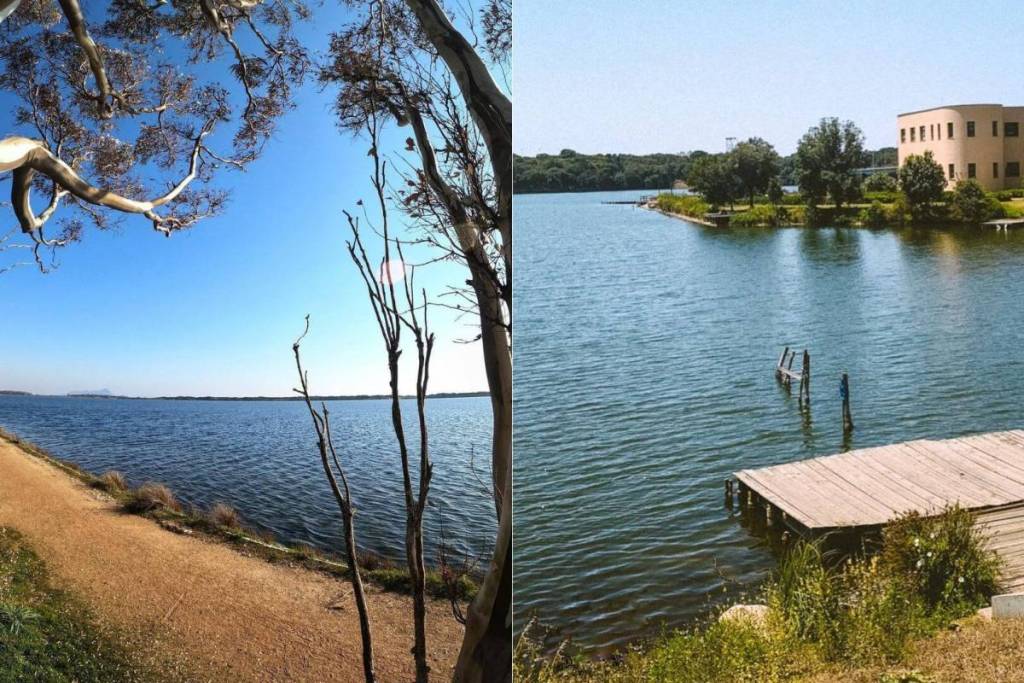

At the Belvedere overlooking Lake Paola in Sabaudia, Legambiente volunteers unfurled a banner bearing just two words: “What a shame.” It wasn’t chosen by chance: it’s the spot where the 2026 data came back worse than anywhere else in Lazio.
Three out of three samples were classified as “heavily polluted.” No other lake in Lazio has as many.
A necessary clarification before moving on: it is the individual sampling points—almost always the mouths of canals and drainage outlets—that have been deemed unacceptable, not the entire body of water.
Then there’s the rest of the picture, and that’s what matters to those who live in Rome and, on Saturday mornings, decide whether to head north or south in their cars. Because the overall picture, this time, is largely positive.
24 sampling points across 10 lakes: here’s how it went
Between July 7 and 9, technicians and volunteers from Legambiente Lazio, as part of the “Goletta dei Laghi” traveling campaign to protect Italy’s lakes, sampled 24 points across 10 lakes: Bolsena, Vico, Bracciano, Albano, Canterno, Fogliano, Turano, Salto, Fondi, and Sabaudia.
The results presented on July 21 were as follows: 18 samples (75%) within legal limits, 5 “heavily polluted,” and 1 “polluted.” All serious issues are concentrated in the same area—the Pontine coastal strip.
The three lakes with the worst ratings
Lake Sabaudia. All three sampling points failed the test: the canal’s outlet at the end of Strada Selva Piana, the canal on Via Orsolini Cencelli, and the ditch under Via dei Bersaglieri. The first two were already known to be problematic; the third was included in the monitoring for the first time and immediately tested positive for contamination.
Lake Fogliano. Here, there was only one sampling point—the mouth of the canal in the Cicerchia area—and even that was found to be heavily polluted. This comes as no surprise: it has been in a critical condition continuously since 2018, with the sole exceptions of 2021 and 2024.
Lake Fondi. Two sampling points, one failing: the San Magno Canal, which has deteriorated compared to 2025 when it was within limits. Good news, however, from the San Vito Canal in Monte San Biagio, which has returned to within parameters after last year’s issues.
Bracciano and Albano pass the test: the weekend’s Plan B holds up
Here, the story takes a surprising turn. All three sampling points on Lake Bracciano were found to be within limits, and this is no fluke: the positive trend has been continuing for years now.
In other words, the Bracciano-Anguillara-Trevignano stretch—the classic fallback when the Rome-Fiumicino highway is closed and the sea near Rome is unmanageable—holds up well in microbiological analyses. For a lake that made national news in 2017 due to a drastic drop in water levels, this is a remarkable recovery.
The same result was found for Lake Albano in Castel Gandolfo, where neither of the two sampling points showed any critical issues. Vico, Canterno, Turano, and Salto also passed across the board.
“Heavily polluted” does not mean a black flag (and it does not mean the lake is off-limits)
This is the point that causes the most confusion every year, so let’s set the record straight. Legambiente does not certify water quality for swimming and does not assess the overall condition of a body of water: samples are taken specifically where the risk is highest—that is, at the mouths of canals, ditches, and drainage outlets.
The analyses test for Escherichia coli and intestinal enterococci, indicators of fecal contamination. A site is considered “polluted” when it exceeds the legal limits for bathing waters, and “heavily polluted” when it exceeds them by more than double.
And what about the black flags in Lazio? They’re a different matter: they’re awarded by Goletta Verde, the coastal campaign, and are given to coastal areas and municipal governments that have failed for years to address their wastewater treatment deficiencies.
Bolsena is improving, but the real challenge lies elsewhere
The best results come from the Viterbo area: of the six sampling points on Lake Bolsena, five are within limits and only one is “polluted”—the mouth of the ditch on Viale Luigi Cadorna—though this is an improvement compared to 2025, when it was heavily polluted.
And that’s the whole difference: between a lucky year and a problem solved lie the wastewater treatment plants. That’s why, this summer, people can swim peacefully in the lakes north of Rome, while a hundred kilometers further south, they’re unfurling a banner.