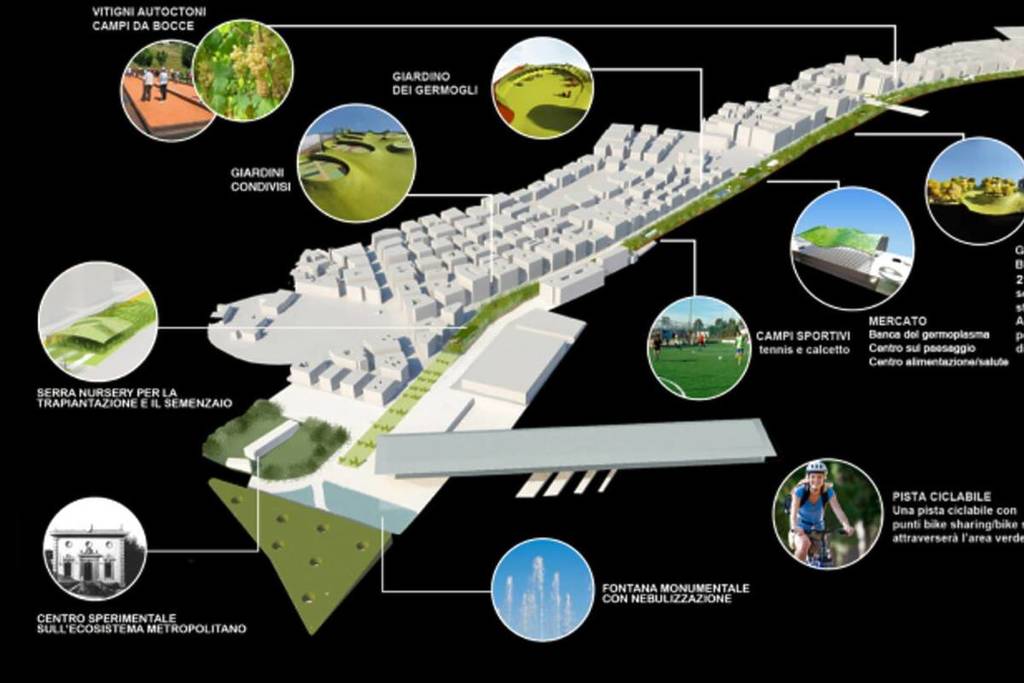
The idea of the Green Ring Road (or Rome’s “High Line”) is one of the most fascinating and talked-about urban regeneration projects in recent years. It is inspired by New York’s famous High Line, the former elevated railway transformed into a linear public park. The main objective is to convert a section of the Tangenziale Est, now disused or underused, into a green pedestrian and cycle path.
The Project: where and how
The focus is on the approximately 2-kilometer stretch between Batteria Nomentana and Via Lorenzo il Magnifico (Tiburtina Station area). After the opening of the Nuova Circonvallazione Interna (NCI), which moved traffic into a tunnel, this part of the elevated road became a concrete “relic” crossing the Nomentano and Tiburtino neighborhoods. The idea, supported by architects (such as Studio Sartogo) and citizens’ associations, and recently revived by the city council, is to maintain the structure instead of demolishing it (which would be expensive and complex) and to ‘reclaim’ the concrete.
Creating an Agronomic Garden
 Unsplash
Over 50,000 square meters of parks, urban gardens, and scientific gardens. Bike paths and pedestrian walkways protected from traffic and smog below. Zero-kilometer markets, playgrounds, leisure areas, and photovoltaic roofs. Why is this important? For decades, the ring road has been a “wound” that has divided neighborhoods. Transforming part of it into a park would reconnect historically isolated areas.
The sulfur from cars would be replaced by plants capable of absorbing CO2 and fine particles, also reducing noise pollution for residents whose windows are just a few meters from the road. As has happened in New York and Paris, these projects tend to redevelop the entire surrounding area, attracting investment and improving quality of life.
Current status
The Green Beltway project received a decisive boost thanks to a council memorandum that transformed the idea into a concrete operational plan. It all started with a motion approved by the City Council in September 2024, initially promoted by Councilor Francesco Carpano. Today, that proposal has become an official guideline for the urban planning and mobility departments, which have been tasked with starting the technical design for the segment connecting Tiburtina Station to Batteria Nomentana.