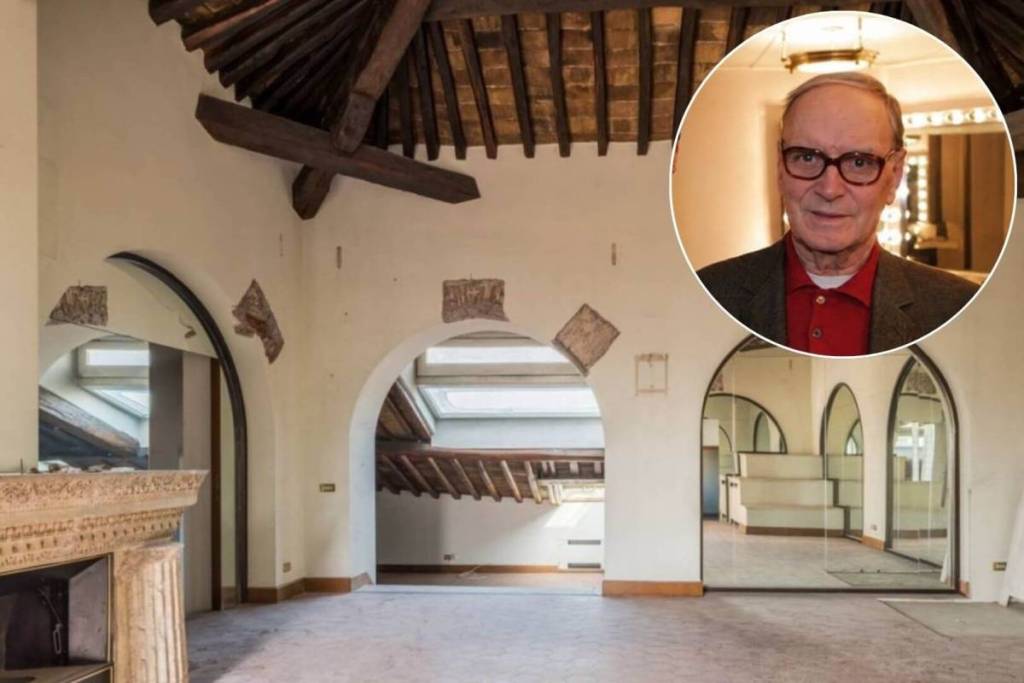

Two golden statuettes on a low shelf, chess magazines on the desk, and, outside the window, the Ara Coeli staircase with the Campidoglio. Ennio Morricone’s studio on Via dell’Ara Coeli has remained just as it was when he worked there.
And it is here that today the foundation established by the family preserves the Maestro’s archive: scores, notes, letters, and hundreds of recordings that no one has yet listened to in their entirety.
And yet, in April 2022, this very same home appeared in Christie’s listings: a two-level penthouse spanning 1,000 square meters between Piazza Venezia and the Campidoglio, listed at 12 million euros.
The news had made headlines in newspapers across Italy and abroad.
A thousand scores, letters, and music for films that were never made: what Morricone’s archive holds
The Ennio Morricone Foundation was unveiled in Rome in December 2025. His wife, Maria Travia, who serves as its honorary president, donated all the unpublished material, including ideas that were never developed and music written for films that were never made.
According to reports published this summer, there are said to be about a thousand scores, in addition to notes, letters, and recordings.
The president is Walter Veltroni, and Giuseppe Tornatore and Nicola Piovani also serve on the board. The task now is to catalog and digitize everything, making it accessible to scholars and enthusiasts.
With 5-meter-high ceilings and a view of the Vittoriano: the home where Morricone lived for thirty years
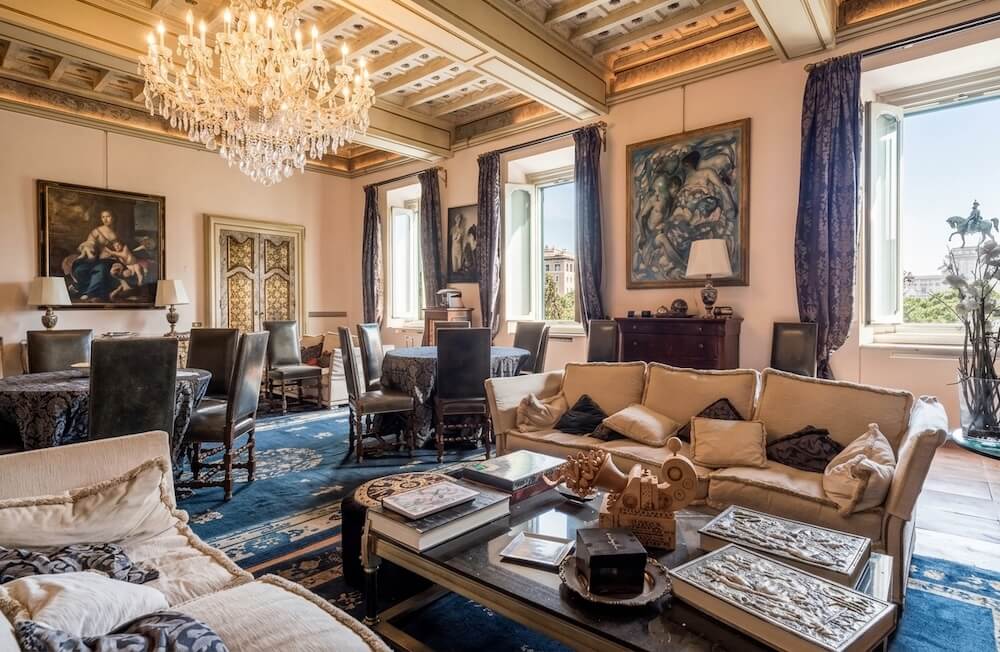
The apartment occupies the third and fourth floors of Palazzo Muti Bussi, in the Campitelli district. It is a 16th-century building which, according to the listing, bears the signature of Giacomo Della Porta, the same architect who designed the fountain located right below it, in Piazza d’Aracoeli.
The 2022 listing described a living room with 5-meter-high coffered ceilings and four windows overlooking the Vittoriano, exposed beams, a 360° terrace overlooking the city center’s rooftops, 15 bedrooms, and 8 bathrooms: specifications rarely seen in luxury homes in Rome.
Morricone lived here for about thirty years, between watching Roma games on TV and playing chess with friends.
In 2017, he moved to the EUR district because the traffic in Piazza Venezia had become too much, and he could no longer open the windows.
Wake up at 4:30 a.m., chess, and sheet music already sorted by instrument: what the Maestro’s studio looks like today
This is described in an article published on the Foundation’s website, which calls it “a forge, not a temple.” Morricone would wake up at 4:30 a.m., do an hour of floor exercises, take long walks around the house, and then shut himself away here to write.
He has won two Oscars: the 2007 Lifetime Achievement Award and the 2016 Oscar for *The Hateful Eight*.
Behind the desk are stacks of staff paper already sorted by section (strings, cellos, oboes, brass, percussion), a sign that he was already thinking of the entire orchestra.
Will the studio open to the public? What we know and where to listen to Morricone in Rome in the meantime
At this time, no dates or visiting procedures have been announced. Among the Foundation’s plans is to transform the studio into a vibrant space for scholars and enthusiasts, with a specific goal in mind: 2028, the centennial of the Maestro’s birth.
For updates, please visit the website fondazionemorricone.it.
Meanwhile, his music has already returned to that square. On July 6, the anniversary of his death, Nicola Piovani conducted a free concert dedicated to Morricone in Piazza del Campidoglio, just a few steps from those windows.