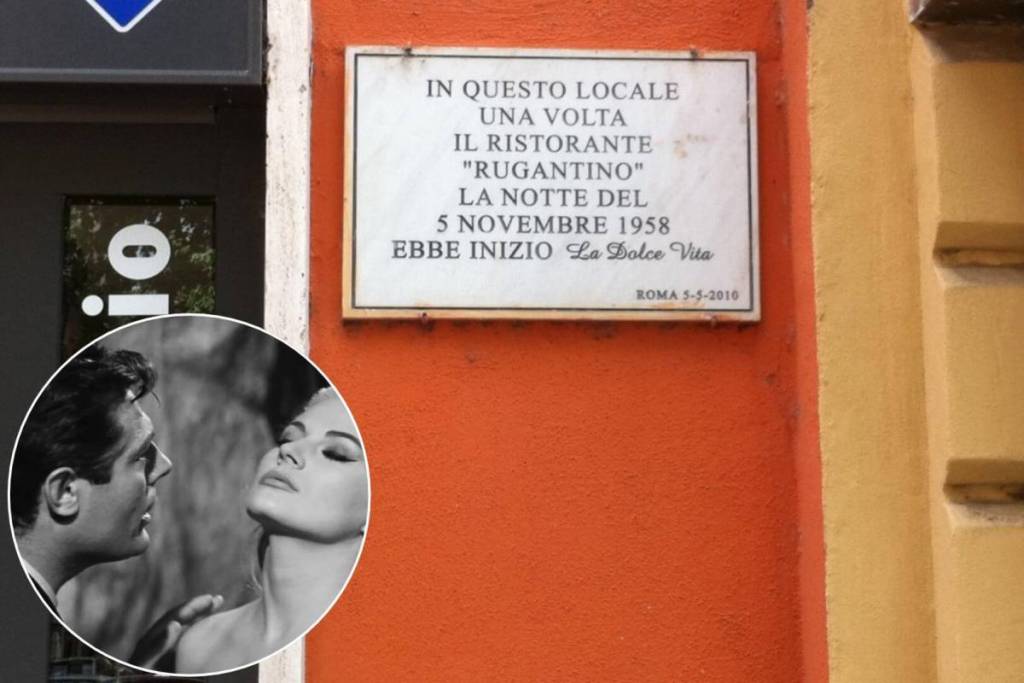

If you get off tram 8 at the Belli stop in Piazza Sidney Sonnino, at number 40 there’s a plaque that almost no one stops to read. It says that there, in a club called Rugantino, on the night of November 5, 1958, “La Dolce Vita began.”
That evening, at a private birthday party for a young countess, an uninvited belly dancer performed until she was nearly naked in front of about 150 guests.
Photos taken by a paparazzo evaded the police, ended up on newsstands, and in the years that followed provided the decisive impetus for striptease to become a nightclub act.
That’s why Rome’s Rugantino has become a legend.
Who was at the Rugantino party: a countess, an American billionaire, and an uninvited guest
The guest of honor was Olghina di Robilant, a Venetian aristocrat who had moved permanently to Rome in 1958. Two days earlier, she had turned 24.
Her friend Peter Howard Vanderbilt—an American scion whom she herself would describe as a billionaire—hosted the evening for her, booking the entire venue along with Carlo Loffredo’s jazz band.
According to accounts, the guest list also included Fellini and Giulietta Masina, though they did not show up.
Instead, Anita Ekberg arrives, accompanied by a throng of photographers and journalists.
Among them was Aïché Nanà, a dancer born in Beirut to Armenian parents, accompanied by Sergio Pastore, the man she would marry years later.
Aïché Nanà’s striptease and the mystery of the film rolls that slipped past the police
When the band picks up the tempo, Aïché takes to the dance floor. The dance turns into a striptease and ends with her on the floor, on a carpet of jackets that some guests have taken off on purpose.
The flashes go off. The countess turns to the police commissioner, who was attending the party as a guest, and asks him to seize the film.
Tazio Secchiaroli, the future king of the paparazzi, was quicker, however: his rolls of film left the venue thanks to a young actor, Matteo Spinola, who would go on to become one of the most famous press agents in Italian cinema.
The photos appeared in *L’Espresso*, with black bars covering the most risqué details, and the November 16 issue was seized.
Too late: by now, half of Italy has seen them.
How the night at the Rugantino ended: fines, expulsion orders, and a billionaire sent back home
According to the countess’s recollections, the dancer was issued a deportation order, and the guests who had laid out their jackets for her were fined. Some accounts add that Vanderbilt was declared persona non grata and escorted by the police to the train at Termini Station.
Other accounts mention a trial for indecent exposure and a two-month sentence for Aïché Nanà.
On one point everyone agrees: the Rugantino is closing, and it will never reopen on Piazza Sonnino.
Did Fellini’s *La Dolce Vita* really begin at the Rugantino? What the facts say
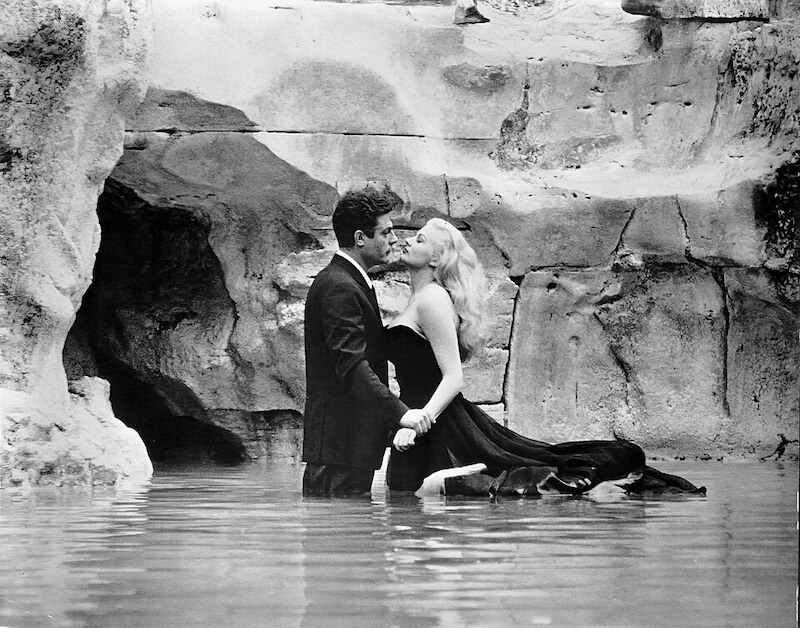
In February 1960, *La Dolce Vita* was released. In the final party scene, set in a seaside villa, Nadia Gray strips beneath a mink coat. Fellini always denied being inspired by the Rugantino, but for Romans, the connection has been obvious for over sixty years.
A clarification for the more nitpicky among you: to say that *La Dolce Vita* was “born” that evening is an oversimplification. Nor did Fellini come up with the name—it was the title of a 1912 comedy by journalist Arnaldo Fraccaroli.
What stands today in place of the Rugantino in Piazza Sonnino (and where its name lives on)
The club was located at numbers 38–40 on Piazza Sonnino, with the dance hall in the basement. After a stint as a McDonald’s, it now houses a bank branch, and the plaque installed in 2010 is the only clue to what happened there.
The name, however, endures: just a few steps away, at 54 Via della Lungaretta, there is a Roman tavern that is still called Rugantino.
The next time you’re passing through Trastevere, stop for thirty seconds in Piazza Sonnino: you’re looking at the spot where one of the most talked-about nights in Rome’s history began.