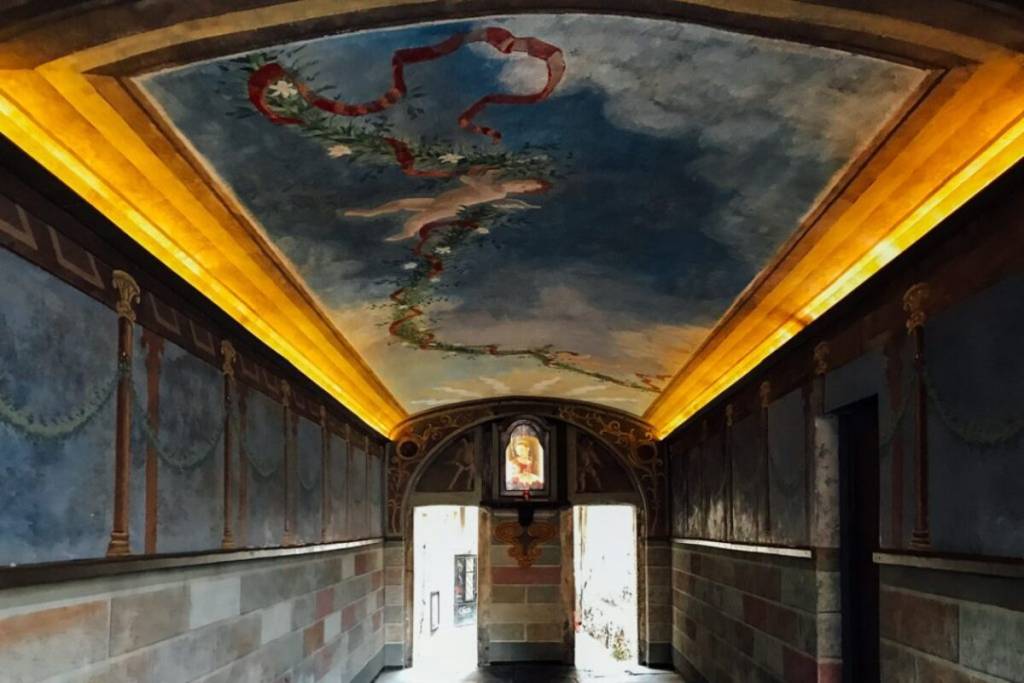

Just a few steps from Campo de’ Fiori, between Via di Grotta Pinta and Piazza del Biscione, there is a covered passageway that many people walk through without realizing what it hides. Its walls and vault are decorated with cherubs and garlands; its history, however, dates back over two thousand years, to the Theater of Pompey. Here, according to historical accounts, in 1796 a statue of the Virgin Mary is said to have moved its eyes.
What’s in the Passetto del Biscione
A passageway linked to the Theater of Pompey
Today, the Passetto connects Via di Grotta Pinta to Piazza del Biscione, but the route has much older origins: in Roman times, it linked the auditorium of Pompey’s Theater with the outside. The theater, inaugurated in 55 B.C., stood right in this area; later, the Orsini family built their palace on top of its ruins.
Frescoes to Look For
Look up as you walk through the corridor: following the restoration carried out by the Centro Studi Cappella Orsini, the colors of the frescoes are once again visible, with cherubs and garlands decorating the walls and vaulted ceiling. An unexpected detail in the maze of streets surrounding Campo de’ Fiori.
The Madonna Who Is Said to Have Moved Her Eyes
In 1796, according to historical sources cited by Roma Capitale, the image of the Madonna del Latte, housed in a shrine inside the passageway, is said to have moved its eyes. The news attracted the attention of the faithful, and after the incident, the passageway was closed off with a wall, leaving two openings to allow passage. The miraculous image was later stolen or went missing.
The Madonna was so well hidden that finding her required searching through the alleys. According to Turismo Roma, this is where the Roman saying “cercare Maria per Roma” (to search for Mary throughout Rome) originated. The image now preserved in the nearby church of San Carlo ai Catinari is a Madonna of Mercy attributed to Scipione Pulzone; a copy of it can be seen in the passageway.