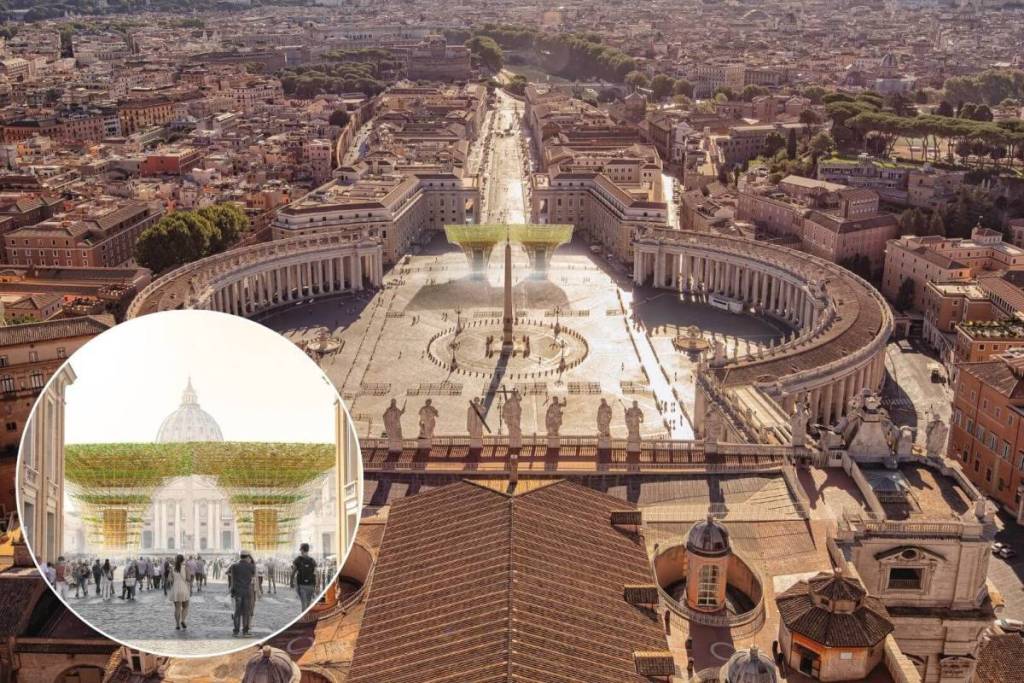

It’s called the Bioclimatic Tree and is, in fact, a natural air conditioner: a structure capable of cooling the air by up to 10 degrees without consuming a single watt. No motor, no refrigerant, no power outlet. Just water, air, and an ancient principle that has recently sparked quite a bit of debate in the city.
Where did the idea for a Bioclimatic Tree come from?
It all began with the Jubilee. At the suggestion of Professor Wittfrida Mitterer, director of the Master’s program in Bioarchitecture at LUMSA, the idea arose to occupy a space that had remained empty for centuries: that of the building designed by Bernini at the entrance to the square, which was never built. An imposing self-supporting bamboo arch would have ideally completed the entrance area of St. Peter’s Square, echoing the visual lines of the Basilica and the volumes of the colonnades.
A physical principle already used in Ancient Egypt
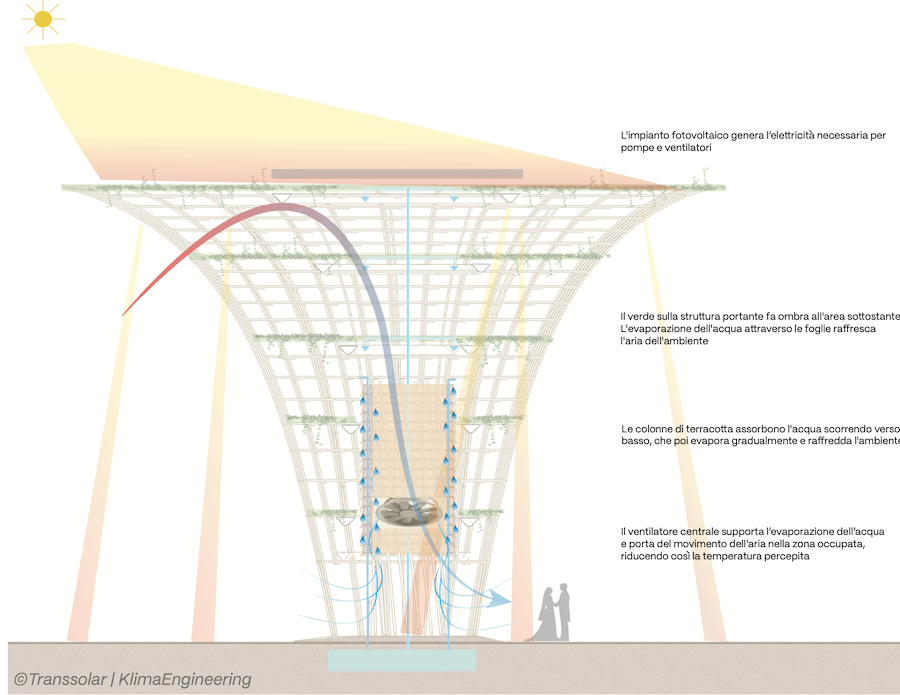
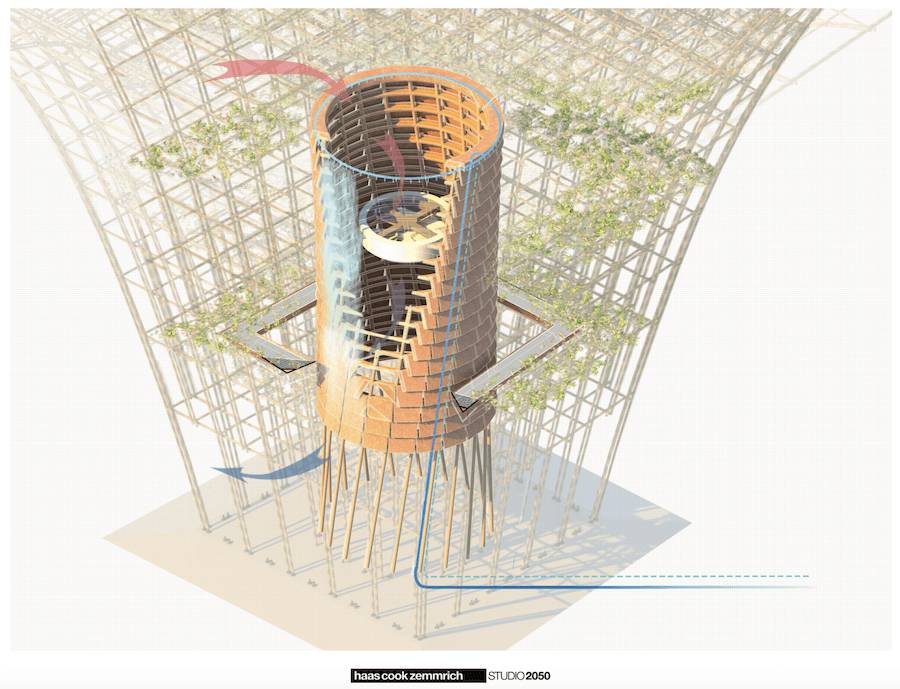
The principle behind this structure is called adiabatic cooling, and it’s by no means new: the same logic was already used to cool the palaces of ancient Egypt and the Zisa Fortress in Palermo. A cylinder made of recycled brick is kept constantly moist: the water evaporates, absorbs heat, and releases a cooler airflow, which is pushed downward by a small fan powered by a photovoltaic roof.
The Termini chapter, closed for now
This is where Rome’s Bioclimatic Tree project was first presented to the general public: as part of the master plan for the redevelopment of Piazza dei Cinquecento, with an estimated cost of approximately 500,000 euros. Sabrina Alfonsi, the councilor for the environment, had described it as “innovative and appealing,” and Christian Rocchi, president of the Order of Architects of Rome, had also highlighted its value.
After technical and financial assessments, however, City Hall decided not to proceed: the high costs and the decision to focus on real greenery have closed, at least for now, the chapter on Piazza dei Cinquecento.
After all, according to the firm that designed it, that structure was never intended to end up there.
An idea that remains open-ended and evolving
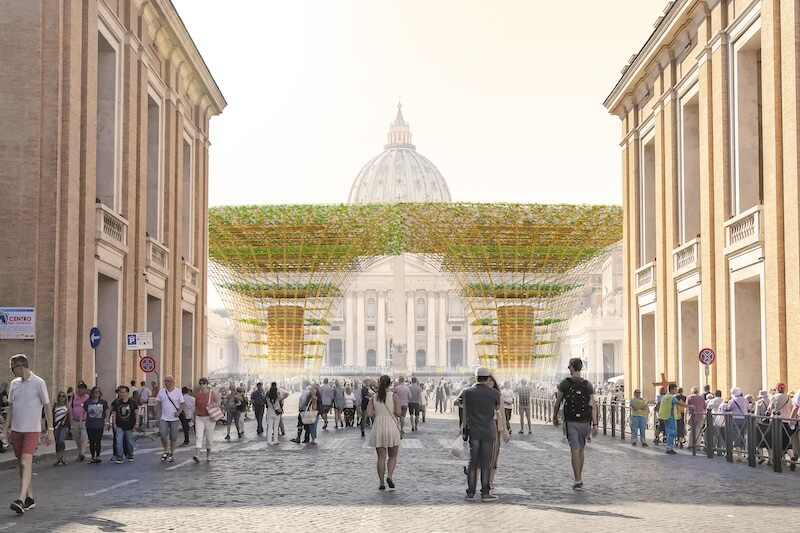
However, the firm behind the project does not consider this the end of the story. Their position is clear: architecture must always be conceived with a specific site in mind, and the structure designed for St. Peter’s would not be moved elsewhere without a thorough review.
Precisely because every major work must interact seamlessly with its surroundings, the designers chose not to simply replicate that design. Piazza dei Cinquecento deserves its own unique icon of sustainability.
That’s why the team is working on a variant designed specifically for already impervious urban spaces, capable of providing shade and cooling with minimal use of materials. And where it’s possible to plant real trees, that remains the first choice.
There is still no final design: just an idea that, after its first chapter in Rome, might resurface elsewhere.